


By Mehmet Enes Beşer
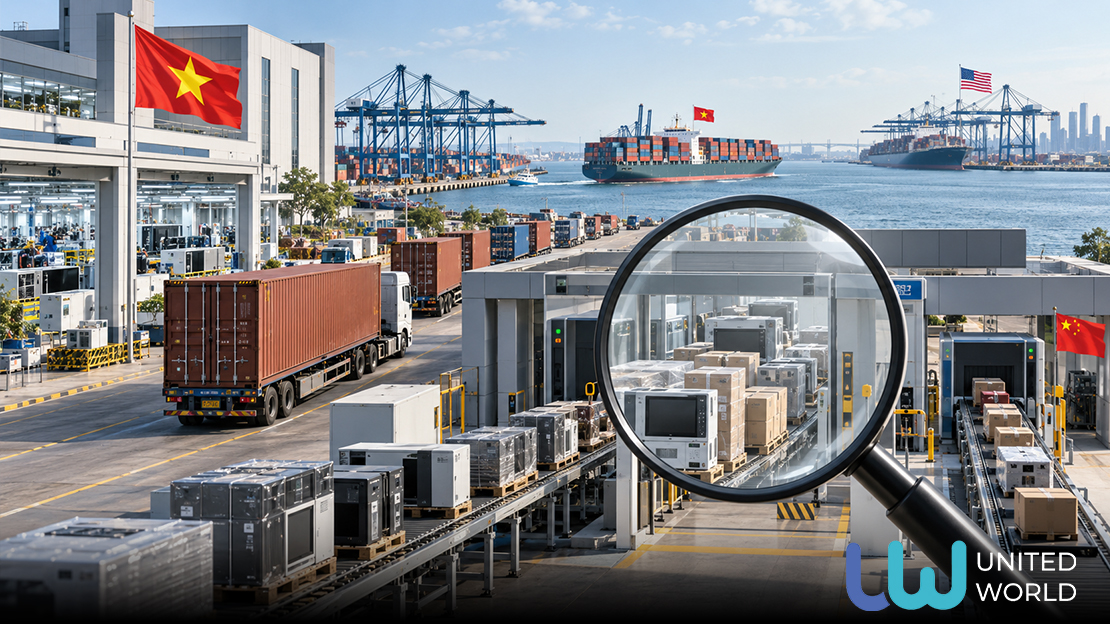
Vietnam’s quickly growing trade surplus with the US has found itself in the middle of a controversy surrounding global supply chains and circumventions of tariff evasion. With the specter of another Trump White House hanging over its head, however, the question is one of whether or not public opinion that China is diverting exports through Vietnam to evade US tariffs rather than whether public perception that it is doing so will drive Vietnam into the crosshairs of America’s trade war strategy again. Even though Chinese diverted goods are fewer in quantity than anticipated, it cannot still absolve Vietnam from culpability, with increasing levels of politicization of trade policy.
During 2018-2023, with increasing ferocity in the US-China trade war, Vietnam experienced record-high increases in its exports to the US—viz., electronics, furniture, garments and textiles, and machinery. Much of it was genuine, rooted in a real shifting of supply chains and greater investor confidence in Vietnam’s industrial base. But with it came another story: Chinese exporters, in front of their own draconian US tariffs, were exploiting Vietnam as a backdoor by transshipping “Made in Vietnam”-labeled goods after minimal or no processing or transshipment.
US policymakers finally caught up and took notice. In 2019, the Trump administration temporarily labeled Vietnam as a “currency manipulator” and slapped tariffs on certain steel products suspected of being produced in China. The US Customs and Border Protection (CBP) also reviewed alleged tariff evasion cases. But exhaustive studies and field data determined that while rerouting cases were indeed found, their scale was smaller than reported in the media. Vietnam’s Chinese and non-Chinese foreign direct investments were more of a realignment of supply chains than a shell game.
But politics is led by appearances. As there is a Trump presidency that has taken the role of equating economic exploitation with trade deficits, Vietnam’s record surplus of running at close to $105 billion in 2023 can once more invite the temptation of retaliatory measures. Without hard numbers, the illusion of a trade deficit can be politically politicized presented in the “American jobs stolen” or “China cheating by proxy” narrative.
The test of Vietnam, then, is to navigate this geopolitical minefield without compromising its economic growth. In contrast to some of China’s other economic partners, Vietnam has tried to diversify trade and forge institution ties with the US. It upgraded its relationship with the US in 2023 to a “Comprehensive Strategic Partnership” and demonstrated shared interests in technology, clean energy, and regional security. The Vietnamese government was also quick in introducing stricter origin rules, increased customs openness, and keeping in line with the US government to enforce violations.
All of that might fall short if there is to be a Trumpian reborn trade policy that will supposedly double down on tariffs, unilateralism, and transactional diplomacy. Vietnam’s neutrality, strategically cautious in normal times, can be tested if Washington pushes for trade concessions or terms on market access. In addition, as Vietnam positions itself between US competitors—practically through regional frameworks like the Regional Comprehensive Economic Partnership (RCEP) and continued engagement with China—it might be between contending economic blocs.
Second in complexity is this new trend towards globalization of production. Multinationals are undertaking “China+1” operations, including Vietnam as an offshoot location rather than one of direct relocation. It thus blurs the lines separating actual diversification from the act of avoidance of duties. With its establishment so highly charged, there is no bargaining power on Vietnam’s side when its trade flow is viewed, even when keeping pace with the international benchmark.
Conclusion
Vietnam’s rising trade surplus with the US is as much an economic success story as it is a story of geopolitical risk. Even if exaggerated, replacement of China on a big scale by Vietnam is political reality more than anything—particularly in a populist, protectionist, prudential environment conditioned by attitudes towards China. A new Trump administration won’t be tolerant. For Hanoi, this is a slimmer tightrope to balance: its export competitiveness, demonstration of compliance with the norms of global trade, and doubling its diplomatic efforts to avoid being caught up in collateral damage from renewed great power competition.
Last but not least, it’s not a question of tariff volumes or volumes of trade. It’s about winning the war of the story in a setting where politics trumps facts. The future direction of Vietnam is not a question of the ability to make things but of the ability to shape perceptions—locally, globally, but most importantly in Washington.