


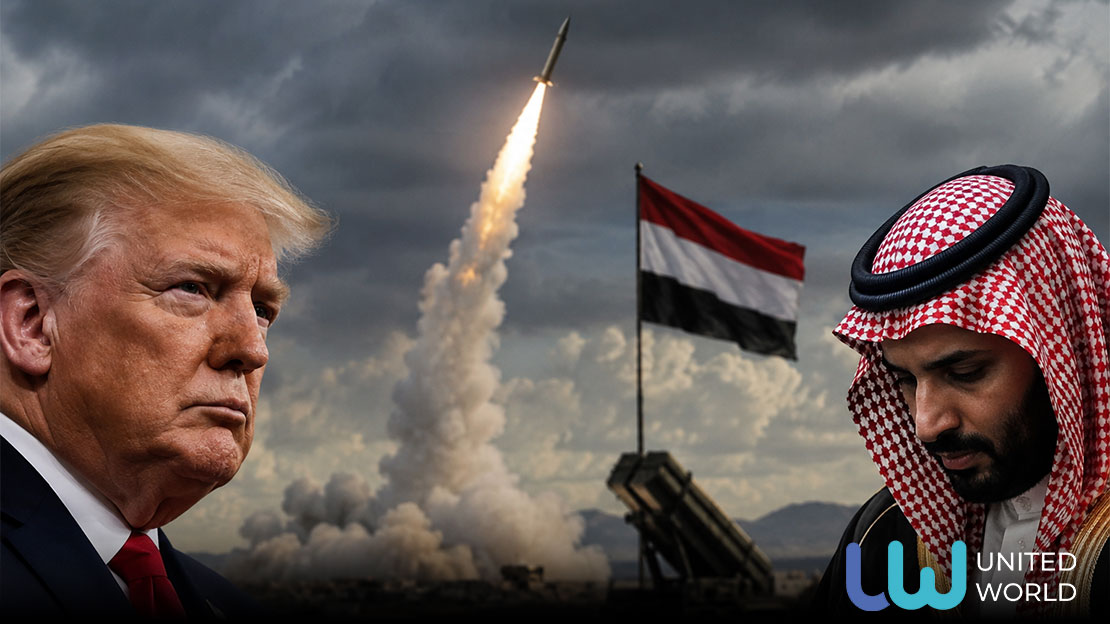
Since the historic summit between King Abdul-Aziz Ibn Saud and US President Franklin D. Roosevelt in 1945, the alliance between Riyadh and Washington has rested on a well-worn, explicit transactional nexus: oil in exchange for security. Yet the ongoing conflict in Yemen—where the Houthis have systematically brought vast swathes of the country under their control—serves as a resounding declaration that this long-standing doctrine has reached its expiry date.
Throughout this campaign, Saudi Arabia’s local proxies collapsed before the Houthi advance with barely a shred of resistance. The rebels have routinely breached every supposedly sacrosanct red line, launching strikes against vital Saudi energy infrastructure and threatening oil shipments through the Bab al-Mandab Strait—a passage Riyadh had heavily relied upon as a strategic bypass following Iranian disruptions in the Strait of Hormuz. Consequently, the Kingdom finds itself strategically suffocated, compelled to plead for the defense of its territory and economy, only to be met with a resounding silence.
American Hesitation
The Trump administration appeared remarkably hesitant to throw Riyadh a lifeline in this hour of dire need. At times, Washington would signal that target packages were being finalized for strikes in Yemen, only for President Donald Trump to blindside observers by pulling back and expressing a sudden reluctance to engage. Shortly thereafter, following a call with Saudi Crown Prince Mohammed bin Salman, Trump would instruct the Pentagon to prepare kinetic options to relieve pressure on the Kingdom—only to reverse course yet again.
Naturally, these vacillations should not be oversimplified as a total American abandonment of Saudi Arabia. Rather, they demonstrate with striking clarity that Washington is no longer capable of rescuing its allies as it once did. At the precise moment Riyadh pleads for protection in an existential crisis, Washington finds itself paralyzed by a labyrinth of strategic constraints, leaving it unable to deliver even a modicum of the salvation the Kingdom seeks.
On one hand, the United States is palpably exhausted by the friction of its months-long confrontation with Iran. On the other, the proxy option—once a viable avenue for projectable power—has completely evaporated. The local forces on the ground backed by Saudi Arabia did not simply fracture; they vanished into thin air, largely because they were a phantom construct from the outset. Riyadh had been funding inflated rosters of fighters who existed solely on paper payrolls rather than on the battlefield. To compound matters, the few battle-hardened formations that did exist pulled back from the Houthi frontlines months ago, driven out by the widening rift between Saudi Arabia and the United Arab Emirates.
Yet this status quo should not invite analytical complacency, nor should we assess the crisis merely through the lens of its current flashpoints. To truly grasp its gravity, one must return to where the first domino fell.
A Grave Threat
Yemen has long represented a paramount strategic priority for Saudi Arabia, dictated by a volatile mix of tribal and sectarian demography and an unforgiving geography. While these factors afford the country significant leverage over regional trade corridors, they simultaneously render it a graveyard for external powers seeking to project their will.
For decades, former President Ali Abdullah Saleh proved adept at cutting transactional deals with Riyadh, successfully insulating the oil-rich Kingdom from the country’s inherent instability. However, the upheaval of the Arab Spring shattered Saleh’s regime and propelled the Iran-backed Houthis to the fore, ultimately prompting Riyadh to launch Operation Decisive Storm in 2015. Years of attrition yielded none of the Kingdom’s strategic objectives—only hundreds of billions of dollars in drained capital—forcing Riyadh to acquiesce to a formal truce in April 2022.
Yet this tenuous framework began to unravel on July 13, 2026, when Saudi-backed Yemeni government forces struck the runway at Sana’a airport to intercept an Iranian aircraft carrying a Houthi delegation returning from the funeral services of the late Supreme Leader, Ali Khamenei. In a bitter geopolitical irony, the Saudi Deputy Foreign Minister was in Tehran at that exact moment extending his condolences. While Riyadh was attempting to extend an olive branch to Tehran, its Yemeni proxies were actively blowing up the fragile quiet with its adversary.
Days later, the Houthis declared a naval blockade on Saudi Arabia. The gravity of the threat was swiftly made tangible when two tankers carrying a combined 2.8 million barrels of oil turned back toward Yanbu after venturing toward the Bab al-Mandab Strait—the first undeniable signal that the peril at the Kingdom’s doorstep had become existential.
Saudi Paralysis
September 10 marked a watershed moment, fundamentally redrawing the battlefield. Houthi forces surged into the port of Mocha and seized control of the strategic islands of Mayun and Zuqar. Mayun, positioned squarely within the Bab al-Mandab Strait, bisects the waterway into two distinct channels; controlling it grants absolute domain over regional maritime traffic and the ability to lay naval mines at will. A mere twenty-four hours later, Saudi Arabia announced the suspension of operations along its East-West Pipeline following a drone strike launched from Iraq.
Yet the true shock lay neither in these rapid territorial shifts nor in the swift collapse of Riyadh-backed proxies. Rather, it was the glaring absence of the Royal Saudi Air Force, which made no attempt to halt the fall of Mocha—a detail disclosed by a Yemeni government military official to the Associated Press.
If this inaction points to anything, it suggests that Riyadh failed to secure a green light from Washington for a large-scale aerial campaign, effectively paralyzing the Kingdom’s hands before any official decision was rendered in Washington.
Emboldened by this strategic impasse, the Houthis redirected their firepower deep into the Saudi interior, striking vital installations in Khamis Mushait, Abha, and Taif, while launching a ballistic missile toward the capital that was ultimately intercepted. Crucially, Houthi representatives explicitly stated to Reuters that they had no intention of targeting American, Israeli, or general commercial shipping—declaring that Saudi-flagged vessels were their sole, designated target.
This policy illuminates the underlying nature of their campaign and its precise ambitions. Framing the Houthis as a mere Iranian proxy executing orders from Tehran is a flawed reduction of their strategic autonomy. Far from generating indiscriminate maritime chaos, their doctrine represents a surgical, highly selective blockade calculated to isolate a single foe: Riyadh. Through this posture, they signal to the international community that global maritime trade remains unthreatened, thereby recasting any intervention to rescue the Kingdom as an optional consideration rather than an urgent priority. While global markets may experience tremors from disruptions to Saudi crude supply, the fallout pales in comparison to the catastrophe of a complete closure of the Bab al-Mandab Strait to commercial traffic.
Under this calculated strategy, Riyadh’s options are unraveling. When Iran disrupted the Strait of Hormuz, Saudi Arabia rerouted its oil exports across the East-West Pipeline to the Red Sea port of Yanbu. For six months, energy markets relied on this precise strategic contingency, operating under the assumption that even with Hormuz compromised, Saudi crude would consistently reach global markets via the Red Sea. That assumption crumbled in a matter of days.
The Saudi state budget stands as the immediate casualty of this strangulation, with crude and refined petroleum sales accounting for more than half of government revenues. Denied its primary maritime arteries, Riyadh’s sole remaining export conduit is the northern route: offloading crude at Ain Sokhna in Egypt and pumping it via the SUMED pipeline to the Mediterranean—a pivot that threatens to transform Cairo into an indispensable, strategic gatekeeper for Saudi energy exports.
The Collapse of the Security Equilibrium
Thus, the dominoes have tumbled since the onset of the US-Israeli campaign against Iran on February 28—a conflict that remains unresolved after nearly seven months. Saudi Arabia and its Gulf neighbors staunchly opposed the war out of fear of its catastrophic fallout, only to find themselves caught squarely in the crossfire.
While the campaign was originally conceived to erode Tehran’s regional influence, the geopolitical paradox is that the losses Iran sustained in Syria, Iraq, and Lebanon have been markedly offset in Yemen. Yet this shift was hardly the product of masterly Iranian design. The Houthis’ operational advances are fundamentally driven by internal dynamics and regional rivalries—most notably the bitter rift between Saudi Arabia and the United Arab Emirates.
A second paradox lies in Washington’s sheer inability to turn Yemen and the Houthis into a direct military objective, as it did with Iran. Most American officials acknowledge that the Trump administration remains deeply skeptical about joining forces with Riyadh against the militia. The US military is already stretched thin by its direct confrontation with Iran, burdened by depleting munition stockpiles and constrained by the looming mid-term elections—all while domestic gasoline and diesel prices surge.
Furthermore, American diplomats and military commanders harbor serious doubts that a limited air campaign could compel a group to negotiate that had already weathered nearly eight weeks of intense US bombardment the previous year. For decision-makers in the White House, the Houthis’ explicit pledge to spare American shipping removes any compelling rationale for opening a new front that poses no direct threat to US vessels.
If recent events have revealed anything to Riyadh, it is that the security equilibrium upon which it built its foreign policy for decades has completely dissolved. Under today’s realities, the American security umbrella is no longer automatic; it has become a conditional transaction bartered for concessions and strategic payoffs. Meanwhile, the Iranian influence that the Kingdom historically factored into its geopolitical calculus has grown far more complex and decentralized. Tehran no longer exerts pressure through a single choke point, but across two strategic straits through local partners—even if it does not command total control over them.
A Volatile Theatre
Yet the most fundamental shift is that Saudi Arabia can no longer claim the mantle of the undisputed regional hegemon whose word is law across the Gulf. It is now paying the price for its intense geopolitical rivalry with a former ally: the United Arab Emirates. This dynamic alone is essential to understanding the shifting and volatile theatre in which Riyadh now maneuvers. Its once-guaranteed strategic interests, historically underwritten by American power, are no longer secure—simply because regional competitors with conflicting agendas are actively asserting their own leverage.
The rapid collapse of pro-government forces along the West Coast cannot be decoded without revisiting the events of last December, when Riyadh systematically pushed UAE-backed forces out of Yemen. That purge was executed to suppress a southern separatist movement that Saudi Arabia viewed as part of a broader Emirati campaign to foster breakaway entities across the region. What alarmed Riyadh most was the prospect of Israel gaining a strategic foothold on the opposite flank of the Bab al-Mandab Strait—a development the Saudis perceived as an Emirati attempt to encircle the Kingdom.
Subsequent events proved that expelling the Emiratis was merely the simple half of the equation; Saudi Arabia swiftly awoke to the sobering reality of its own fragile influence inside Yemen. With Abu Dhabi’s exit from the board—at least ostensibly—Riyadh inherited the command of a fractured ground force with irreconcilable objectives. Intelligence reports suggest that up to 80 percent of these troops were phantom fighters collecting salaries without ever engaging in combat, while the Houthis successfully breached their internal communications. The Saudi-backed coalition was little more than a fragile patchwork of anti-Houthi factions that spent more energy locked in internecine feuds than confronting their common enemy.
More alarming still, Abu Dhabi’s apparent withdrawal from the Yemeni battlefield may have paved the way for a tacit convergence of interests between the UAE and the Houthis. Unconfirmed reports circulate that the Emiratis facilitated a backchannel line of communication between Washington and the rebels. Regardless of whether these reports can be independently verified, the very fact that Saudi officials lend credence to them—and actively echo them—underscores the profound rift and mutual suspicion dividing Riyadh and Abu Dhabi.
In truth, as The Sunday Times noted, the Saudi-Emirati alliance constituted the most effective front against the Houthis between 2015 and 2018. The UAE outmaneuvered the Houthis across every operational theater it entered, deploying specialized military capabilities that proved decisive in reclaiming strategic islands and enabling Yemeni ground forces under Saudi air cover. This does not imply that Riyadh’s sole salvation lies in resurrecting its alliance with Abu Dhabi—a prospect that founders on the reality that Saudi Arabia sought to marginalize the UAE for deep strategic and sovereign reasons. Yet it starkly highlights the narrowing margin of options available to the Kingdom in light of its tenuous grasp on the ground.
Narrow Options
Against this constrained backdrop, some analysts view Washington’s apparent abandonment of Saudi Arabia not as a mere byproduct of situational complexity, but as a deliberate lever of pressure designed to compel Riyadh into a normalization deal with Israel. The Kingdom, however, maintains an uncompromising stance on the issue, strictly conditioning any rapprochement on a credible, irrevocable pathway to Palestinian statehood. Certain indicators lend credence to this theory, as various external actors perceive Riyadh’s current vulnerability as an opportune moment to wring political concessions.
Yet, plausible as this interpretation may be, pursuing such a path carries prohibitive costs for the Kingdom. Under present conditions, the price of normalization vastly outweighs its dividends. Chief among these liabilities is Israel’s inability to project the specific military capabilities required to resolve a conflict as structurally complex as the Bab al-Mandab crisis. Furthermore, the Houthis would instantly transform normalization into a potent propaganda weapon against Riyadh—precisely while the Kingdom accuses them of attempting to strike Holy Mecca. Crucially, any such move would be universally interpreted as a capitulation under duress: the worst possible strategic moment to yield leverage.
This intricate geopolitical squeeze raises a fundamental question: Was the Mecca Pact, signed by the Kingdom weeks ago with Turkey and Pakistan, a calculated hedge against American abandonment? And if so, why has this coalition failed to deliver, and why has Riyadh refrained from requesting direct defensive support from its treaty partners against the Houthi threat?
Over the past year, Saudi Arabia did not merely sign the Mecca Pact; it also launched a multilateral maritime alliance for Red Sea security, solicited security guarantees from Washington and European capitals, and inked a defense pact with Ukraine to insulate itself against such contingencies. To date, however, the practical yield of these efforts has remained strictly political, lacking the operational muscle required to deter either Iran or its regional proxies.
Regarding the Mecca Pact specifically, the treaty suffers from structural flaws in its core design. While it frames an assault on one signatory as an attack on all, it lacks any binding mechanism mandating direct military intervention. On September 10, Islamabad explicitly clarified that current developments did not warrant a military response, maintaining that its commitments were strictly forward-looking and limited to prospective conflicts.
According to observers, Riyadh’s partners view the Yemeni crisis as an internal civil war in which Saudi Arabia is an active combatant—a flare-up triggered after its Yemeni proxies struck Sana’a airport. Politically and militarily, it is nearly impossible to persuade two foreign partners to wage war in defense of a state perceived to have instigated the latest cycle of escalation.
Furthermore, both Ankara and Islamabad have their own strategic constraints. Pakistan shares a long, volatile border with Iran and fears the domestic security repercussions of getting drawn in. Turkey, meanwhile, prefers to position itself as a diplomatic mediator—a posture made explicit when its Foreign Minister delivered de-escalation proposals to both sides.
Compounding these limitations, neither nation possesses significant naval or expeditionary power-projection capabilities in the Red Sea, nor is the founding charter of the alliance strictly defensive, explicitly precluding offensive maneuvers against the Houthis. Ultimately, the complete collapse of local Yemeni proxies has decimated any operational maneuvering room for external powers to assist the Kingdom; any viable intervention requires a capable Yemeni ground force, a force that dissolved at the very first point of tactical contact.
An Egyptian Role
Given Saudi Arabia’s narrowing strategic options, Crown Prince Mohammed bin Salman’s visit to Cairo was viewed by many analysts as unusual in both its timing and context. Yet pragmatic, realpolitik considerations strongly favored the summit. Egypt possesses immense military weight, holds critical economic stakes directly tied to Suez Canal security, serves as a cornerstone partner in the Saudi-led maritime coalition, and offers a crucial alternative crude export route via Ain Sokhna and the SUMED pipeline.
In practice, Cairo maintains a strict ceiling on direct military involvement inside Yemen, conditioned by the bitter memory of its 1960s intervention when Egyptian forces suffered heavy attrition while supporting the republican faction against the Imamate regime. Nevertheless, Cairo exhibits no reluctance to participate in a broader international coalition to safeguard freedom of navigation in the Red Sea. This likely formed the core consensus reached with the Saudi Crown Prince; immediately following his visit, Major General Osama Abdel Hamid Dawood, Commander of the Egyptian Border Guard Forces, affirmed ongoing coordination with Saudi Arabia to secure shared maritime borders, the Gulf of Aqaba, and the southern reaches of the Red Sea amid rapid regional security escalations.
Politically, Egypt is uniquely positioned to mediate and prevent the military confrontation in the Red Sea from spiraling out of control. This posture is not merely driven by Cairo’s anxiety over Red Sea shipping disruptions, which directly threaten Suez Canal revenues at a time when Egypt continues to navigate a suffocating economic crisis. More fundamentally, Cairo fears an uncontrolled escalation that could force a direct clash with actors benefiting from the status quo—most notably the UAE and Israel, both of which are aggressively expanding their strategic footprint across from the Bab al-Mandab Strait via Ethiopia and Somaliland. Consequently, the official Egyptian statement following the Crown Prince’s visit expressed explicit solidarity and called for a comprehensive political settlement, while carefully avoiding any firm commitment to boots on the ground.
This diplomatic posture closely mirrored the communiqué issued following the visit of CIA Director John Ratcliffe to Cairo. According to the Egyptian Presidency’s official statement, the two sides discussed ongoing conflicts involving Iran, Gaza, and Sudan, alongside threats to Gulf States and international maritime security. President El-Sisi reiterated Egypt’s unreserved support for Somalia’s sovereignty and territorial integrity, while Ratcliffe emphasized the vital importance of US-Egyptian coordination regarding Somalia, Sudan, and maritime safety.
While the specifics of behind-closed-doors deliberations remain undisclosed, the contextual evidence invites a compelling analytical reading. The timing is striking, and the agenda intersects directly with the crisis—encompassing maritime security, the Horn of Africa, and Cairo’s exceptional capacity to dialogue with opposing regional players. Equally telling was El-Sisi’s explicit rejection of any infringement on Somali unity in his talks with Ratcliffe—a position that implicitly counters Israel’s diplomatic trajectory toward recognizing Somaliland. Through these dual summits, Cairo effectively positioned itself as an indispensable stabilizing force capable of guaranteeing maritime security in a manner that serves both Saudi and American strategic interests.
A Potential Inferno
To view the Houthis’ control over the Yemeni choke points of the Bab al-Mandab Strait purely as an Iranian plot to seize regional waterways and command strategic influence is to ignore the critical dynamics unfolding on the opposite shore.
On the African bank, Israel’s diplomatic recognition of Somaliland in December 2025 cemented an emerging alignment between the UAE, Israel, and Ethiopia. This coalition is actively attempting to establish footholds along the Red Sea coastline to monitor and manage maritime traffic. However, with Houthi forces occupying Mayun Island, every strategic project built by the UAE and its allies in the Horn of Africa now falls within the direct envelope of Houthi ballistic firepower.
Worse still, the Houthi leadership has explicitly warned that any Israeli presence in Somaliland will be treated as a legitimate military target. Such a posture threatens to deepen ties between the Houthis and Al-Shabaab in Somalia, risking the spillover of the Yemeni conflict across the entire Horn of Africa. This escalation could trigger fierce military confrontations—both direct and by proxy—among competing regional powers, ultimately transforming the Red Sea into a geopolitical inferno with global reverberations.
Consequently, the Houthi stranglehold on the Bab al-Mandab Strait is no longer merely a Saudi headache, but an acute regional and international crisis drawing in a web of competing stakeholders. Should this conflict ignite fully, predictable outcomes will cease to exist for any actor involved.
Conflict Management
It is precisely within this context that Cairo, flanked by Washington, is aggressively seeking to contain the impending fallout before it metastasizes. The strategy centers on brokering direct negotiations between Riyadh and the Houthis via multi-track diplomacy in Muscat, Ankara, and potentially Beijing. The objective is a pragmatic modus vivendi: halting cross-border strikes and guaranteeing freedom of navigation in exchange for economic concessions and a tacit accommodation of Houthi political demands.
Concurrently, the Kingdom may be forced to pursue a parallel track of structural economic adaptation. This would entail overhauling its oil export architecture on the baseline assumption that both strategic choke points—Hormuz and the Bab al-Mandab—will remain permanently volatile. Under such a doctrine, Riyadh would offload a substantial share of its crude through ship-to-ship transfers off Sohar in Oman, expand its reliance on Egypt’s SUMED pipeline to the north, scale up strategic crude reserves, and fortify its air defense envelope. While prohibitively expensive, this strategy preserves state cohesion—though it merely buys precious time rather than resolving the core crisis.
Yet the ultimate lesson for Saudi Arabia from this ordeal is that strategic security cannot be bought through transactional deal-making alone. The Kingdom expended vast fortunes acquiring the world’s most sophisticated weaponry, only to find its air force hamstrung by geopolitical constraints, its local proxies collapsing on the ground, its primary international guarantor wavering, and its oldest regional partner transformed into an adversary. Moving forward, Riyadh will be forced to fundamentally redefine its national security calculus—expanding its focus beyond physical border defense to actively safeguarding its energy lifelines, securing strategic maritime corridors, and building genuine, resilient local alliances.