


By Azar Mahdavan, from Tehran / Iran
The recent advances and victories achieved by Yemen’s Ansarullah forces along the country’s western coast have come as a major and unexpected development for all sides and observers following the strategic shifts currently unfolding in the Middle East and the Persian Gulf. These developments could have far-reaching and direct consequences beyond the region.
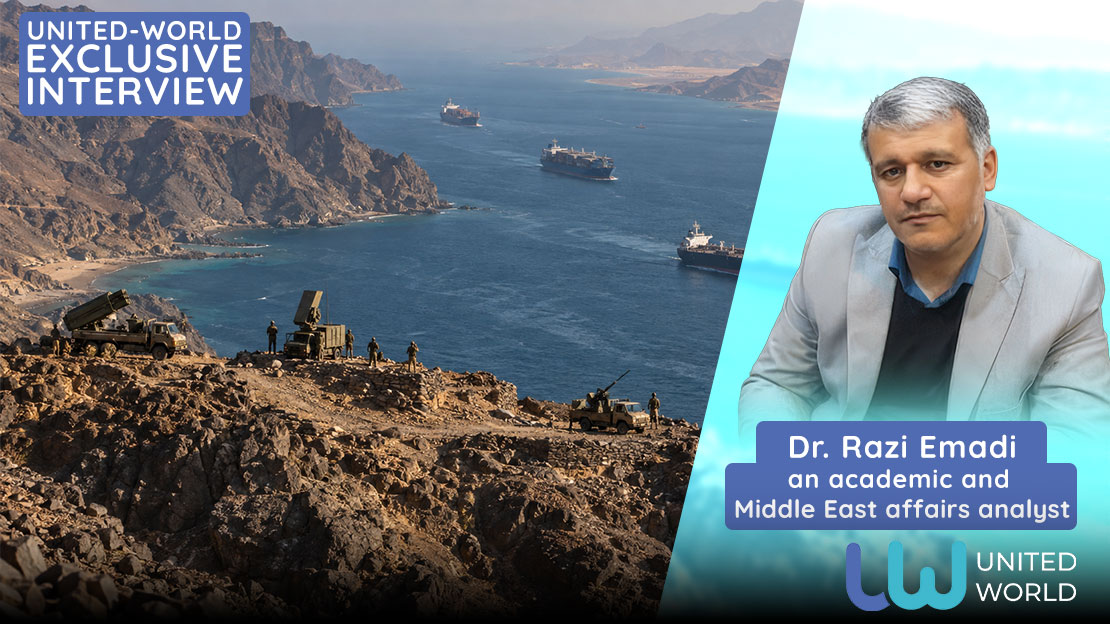
Against this backdrop, we spoke with Dr. Razi Emadi, an academic and Middle East affairs analyst. The following is the full interview.
How were the Yemeni forces able to reach the Bab al-Mandab Strait in a matter of days? What explains their rapid advance?
Several factors should be taken into account when answering this question. First is the high level of readiness among the Yemeni forces. At present, the National Salvation Government based in Sana’a is considered one of the most cohesive political and military actors in Yemen. Politically, it operates in an organized manner, with fewer internal divisions and tensions. Militarily, it has demonstrated a high level of preparedness and continues to strengthen its capabilities.
These forces have drawn on their experience from the eight-year war with Saudi Arabia and have spent years building up their military capabilities. It is also important to remember that during the Israeli war on Gaza, Ansarullah in Yemen, alongside Hezbollah, was among the few Arab actors that became directly involved in support of Gaza and carried out attacks against Israel. Therefore, Ansarullah and, more broadly, the military forces aligned with the National Salvation Government were already highly prepared militarily before the latest developments.
Alongside the buildup of military capabilities, an effective indigenous manpower base has also been an important factor behind the advance. This creates a significant difference between the Yemeni forces and some of the forces opposing them. Local Yemeni fighters have a stronger connection to their homeland, greater motivation to defend it, and have continued to receive military training and gain battlefield experience. Taken together, these factors have enabled them to operate more effectively and advance more rapidly on the battlefield.
The second factor concerns the condition of the opposing forces. What we are seeing is that some of these forces lack sufficient cohesion and military preparedness, while some simply do not have the motivation necessary to fight. National, territorial and geographic ties are not as strong among them as they are among local Yemeni forces, which can contribute to lower morale and a more rapid collapse.
This issue has also been evident among forces aligned with Saudi Arabia. During the eight-year Saudi war against Yemen, one of the Saudis’ major weaknesses was their reliance on mercenary forces—fighters who had no national or territorial connection to the battlefield and operated in return for financial compensation. Naturally, under wartime conditions, such forces do not have the same motivation or staying power as an indigenous force. This has also contributed to the rapid advance of the Yemeni forces.
There is another important factor that should also be taken into consideration: the Yemenis are seeking to present a new image of themselves to the region. They want to establish themselves as an actor capable of defending itself and as a force fundamentally different from Yemen under Abdullah Saleh and Mansour Hadi.
Today, Yemen is seeking to capitalize on its various strengths and capabilities and establish itself as a new player in the region’s military and political developments—a player that is close to the Axis of Resistance and capable of supporting other actors within that camp. We had already seen this during the war in Gaza. Taken together, these factors can be considered among the main reasons behind Ansarullah’s rapid advance toward Bab al-Mandab and its recent battlefield gains.
What impact does Ansarullah’s advance toward Bab al-Mandab have on the regional balance of power, particularly given Iran’s closure of the Strait of Hormuz?
This issue needs to be examined within the broader context of regional developments. For nearly three years, the West Asian region has been witnessing a war against the Axis of Resistance, and the conflict has gradually intensified. Following October 7 and the escalation of Israel’s military operations in Gaza and the relative weakening of Hamas, Israel turned its attention to Lebanon, then became involved in Syria, and subsequently launched military action against the Islamic Republic of Iran. The 12-day and 40-day wars should also be viewed within this broader context.
Against this backdrop, Ansarullah’s advance toward Bab al-Mandab carries an important message: the Axis of Resistance has neither retreated nor collapsed; rather, it continues to pursue its objectives on the battlefield.
The second point is that Iran and its allies, including Ansarullah, are seeking to make use of the advantages available to them on the battlefield. One of the most important of these advantages is geography. When an adversary has superiority in military capabilities, intelligence and technology, a party that lacks such advantages can turn geography into a strategic tool.
The Islamic Republic of Iran, which had not previously used the Strait of Hormuz as a military instrument, is now making use of this capability. However, this use is defensive in nature and does not constitute an offensive measure. Ansarullah in Yemen, meanwhile, is moving toward a position where it can use the strategic potential of Bab al-Mandab as a military lever.
Although the war against Yemen has ended, the Saudi blockade of the country continues, albeit with varying degrees of intensity at different times. Therefore, by confronting Saudi-backed forces and seeking to gain control over Bab al-Mandab, Ansarullah is attempting to use its geographic advantage as a military tool and increase the economic costs of the blockade for Saudi Arabia.
This is particularly significant for Saudi Arabia because, on one side, Iran has activated its capabilities around the Strait of Hormuz, while on the other, Ansarullah is seeking to exert influence over Bab al-Mandab in the Red Sea. In effect, these developments demonstrate that geopolitics can still play a significant role in warfare.
The consequences are not limited to the region and could also affect the global economy. Just as disruptions to shipping through the Strait of Hormuz can affect the global economy, restrictions on traffic through Bab al-Mandab would also have economic consequences. The rise in oil prices in recent days, coinciding with Ansarullah’s advance toward Bab al-Mandab, highlights the sensitivity of global markets to these developments.
From this perspective, one possible objective of these actions is to increase economic pressure and force the international community to confront the consequences of the continuation of the war and the blockade—in other words, to prevent the war from continuing and bring an end to the blockade of Iran and Yemen.
At the same time, these developments affect the regional balance of power and demonstrate that geographic advantage remains one of the important components of power for the Axis of Resistance. Ansarullah’s actions have also highlighted the vulnerability of some Arab states, particularly Saudi Arabia, to attacks originating from Yemen.
One of the key questions is why the Mecca agreement was not activated despite the Houthi attacks on Saudi Arabia, and why Türkiye and Pakistan did not take any concrete military action in support of Saudi Arabia.
First, it should be noted that the Mecca agreement is a newly established pact. In my view, at this stage, the agreement serves more of a psychological and deterrent purpose than an operational military one.
Through this agreement, Saudi Arabia, Pakistan and Türkiye sought to send a message that Saudi Arabia would not stand alone in the event of a threat and that its partners would support it. The agreement also conveyed a message to countries that might target Saudi Arabia, including Iran and Ansarullah, that Riyadh has the backing of its allies.
However, it was clear from the outset that the pact would not necessarily translate immediately into military action. One reason is simply that it is still a new agreement. The circumstances could be different if Saudi Arabia were to come under attack several years from now, and the parties might then be in a different position to fulfill their military commitments. At present, however, entering the war could impose significant costs on all three countries.
West Asia remains embroiled in multiple crises and conflicts, and it is unclear when or how the current confrontations will end. Moreover, entering a war against Iran or Ansarullah would not necessarily remain confined to that particular battlefield and could draw other countries into the conflict.
We saw this during the US-Israeli war against Iran as well, when military attacks and developments affected US and Israeli bases and interests in various countries across the region. Türkiye and Pakistan therefore have to take their own interests and security considerations into account.
Pakistan faces security threats related to India, while Türkiye is also dealing with serious threats and challenges in the region. Under such circumstances, directly entering another war would not necessarily serve either country’s interests.
For this reason, I do not think the failure of Türkiye and Pakistan to intervene militarily at this stage can be regarded as a definitive test of the Mecca agreement. The pact is still in its early stages and, at least for now, its psychological and deterrent role has been more significant than its military function.
Axios has reported that Saudi Crown Prince Mohammed bin Salman contacted Trump twice and asked the United States to enter the war in Yemen, but Trump rejected the request. Why did Trump choose not to enter the war in Yemen at this point or intervene to stop the advance of the Yemeni forces?
One possible explanation is that Trump wants to remind Saudi Arabia that moving toward new defense partnerships and relying on other countries does not necessarily provide an effective alternative, from Washington’s perspective, for guaranteeing the kingdom’s security.
Although the United States has officially supported the Mecca agreement, one possible interpretation is that Trump is using the current situation to reinforce the message that if Saudi Arabia has signed the Mecca pact, it should first rely on the countries with which it has entered into that agreement to defend it.
From this perspective, the US decision not to intervene directly could convey the message that Washington still regards itself as the primary provider of security for Saudi Arabia and does not view Riyadh’s new partners as a complete substitute for the United States.
Trump has previously emphasized that Saudi Arabia needs US support to ensure its security. Now, with Saudi Arabia facing the challenge posed by Ansarullah forces, it can be argued that Trump may be seeking to place greater emphasis on Riyadh’s continued security dependence on Washington.
At the same time, direct US involvement in another war would carry significant costs for Washington. The United States is currently engaged in a war with Iran, and managing an additional military front under these circumstances could prove difficult and costly for the US.
Therefore, the decision not to intervene can be viewed as a combination of considerations surrounding Washington-Riyadh relations, the potential costs of another war, and the broader circumstances in the region. Under these conditions, Trump may prefer to avoid entering another war unless he considers the necessity of direct US involvement and its potential costs acceptable.