


By Arman Ahmadi, International Affairs Researcher, from Tehran / Iran
At first glance, the “Joint Defense Agreement” signed by Saudi Arabia, Türkiye and Pakistan in Mecca on August 7 might look like just another Middle Eastern security pact — three countries with powerful militaries, deep pockets, and long-standing ties to major powers coming together. But its significance can’t be measured in troop numbers, fighter jets, or hardware alone. What matters most lies beyond the text itself: the picture it paints of a Middle East in transition, where governments — especially after the US-Israeli war on Iran — no longer want to entrust their security to a single outside power.
For Iran, this poses a real dilemma. Tehran has long argued that Middle Eastern security should be guaranteed by the countries of the region themselves, and that the presence of outside powers — the United States chief among them — is not a guarantor of stability but can become part of the problem. Now three major regional and Islamic-world powers have taken a step in that direction without Iran. Seen this way, the Mecca agreement is, for Tehran, both good news and a source of worry at once.
The good news is that the region’s traditional reliance on the American security umbrella no longer looks like the only option. The worry begins where a new security architecture takes shape while Iran stands outside the room where it’s being designed. That may be why Tehran’s response has been neither an alarm over the birth of an “Islamic NATO” nor an unqualified welcome for a regional initiative.
Iran’s official language is more cautious than extreme. Rather than debate the principle of trilateral security cooperation, Tehran has posed a different question: where should regional security actually come from, and what is the real threat in the Middle East?
The Mecca Agreement: Military Pact or Sign of a Bigger Shift?
The agreement was signed at a moment when the old picture of Middle Eastern security has cracked more than ever. Successive wars, strikes on energy infrastructure, insecurity along shipping lanes, and doubts about how far and how long US commitments will hold have pushed many regional governments to rethink their calculations.
Its central clause treats an armed attack on any one member as an attack on all three — language that politically echoes collective-defense arrangements. But there’s a considerable gap between such a commitment on paper and an actual working military alliance.
It still can’t be said with certainty that Saudi Arabia, Türkiye and Pakistan have become an integrated military structure with a joint command, standing forces, and a clear trigger for entering a war. What is clearer for now is the political will to draw the three closer together on security and defense.
Each brings something different to the table. Saudi Arabia brings money, energy, and the geopolitical weight of the Persian Gulf; Türkiye brings a large military, operational experience, and a defense industry that has become one of Ankara’s chief instruments of regional power in recent years. Pakistan adds military experience, a long security relationship with Riyadh, and — perhaps most importantly — the strategic weight of a nuclear-armed state.
Pooling these capabilities, though, doesn’t necessarily mean sharing a common enemy. Saudi Arabia is focused above all on threats from Yemen and its rivalry with Iran. Türkiye weighs Israel, Syria, Iraq, NATO, and its own independent ambitions. Pakistan, for its part, still puts India at the center of its defense planning.
The Mecca agreement thus sits at the intersection of shared interests and deep differences among its three members — which is exactly what makes Tehran’s reading of it so complicated.
The View from Tehran
Iran’s official response may be the best key to understanding the agreement. Foreign Ministry spokesman Esmaeil Baghaei framed it not as a threat but as evidence of a “shift in how regional states understand” security. Regional countries, he said, have concluded that security isn’t a commodity that can be bought from abroad, and he stressed the need for regional cooperation and homegrown security that doesn’t rely on outside actors.
On its face, this position could even bring the Mecca agreement close to the very path Iran has advocated for years.
But Tehran’s objection begins over how “threat” is defined. In Iran’s official view, regional security is one interconnected whole. Pointing to the war in Gaza and Israeli strikes on regional states, Baghaei named Israel and US backing for it as among the chief sources of insecurity. From this vantage point, cooperation among regional states can only serve security if the threat is correctly identified. Tehran, in other words, has not challenged the principle of building regional security mechanisms — the question is what definition of enemy and threat such a mechanism rest on.
If the Mecca agreement is read as a step toward reducing the region’s dependence on outside powers, it overlaps with Iran’s own strategic narrative. If the same mechanism gradually turns into a vehicle for containing Iran, it will mean something entirely different to Tehran.
These nuances matter. Iran has not officially branded the Mecca agreement an anti-Iranian alliance. Even when reports surfaced that Iran had been invited to join, the Foreign Ministry said Tehran had received no official invitation — so claims about Iran’s possible membership cannot be treated as the Islamic Republic’s official policy.
There Is No Single Iranian View
Step back from the government’s official position, and a far more fragmented picture emerges. Among Iranian analysts, media, and political figures, the Mecca agreement is seen through two very different lenses.
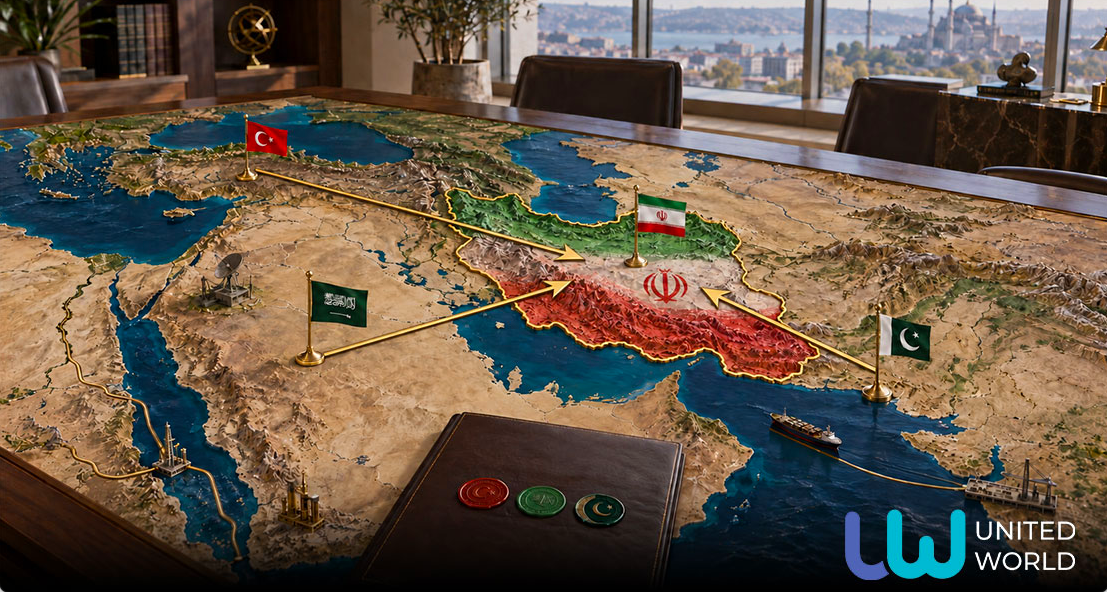
One focuses on geography: the three member states sit on three sides of Iran’s strategic space — Türkiye to the northwest, Pakistan to the southeast, Saudi Arabia across the Persian Gulf. From this angle, closer security cooperation among them could form a ring of political, intelligence, and economic pressure around Iran — and, should the pact evolve, military pressure too.
A second view starts from the same premise and reaches a different conclusion: would Türkiye and Pakistan really go to war with Iran on Saudi Arabia’s behalf? That question doesn’t yet have a clear answer.
Türkiye is Iran’s rival, but also its trading partner and neighbor. Their interests in Syria, Iraq, the Caucasus, and energy sometimes align and sometimes clash, and Ankara has independent goals that don’t necessarily match Riyadh’s or Washington’s. Pakistan is in a comparable, though different, position: its long border with Iran, its economic ties, domestic sensitivities, and its history of mediating between Tehran and Washington all make it harder for Islamabad to slide easily into direct confrontation with Iran.
That’s why part of Iranian analysis reads the Mecca agreement not as a war pact but as a deterrence mechanism. The two readings converge on one point: the agreement’s real meaning won’t be decided at the signing ceremony but in its first serious crisis.
If, in a crisis, Türkiye and Pakistan offer only political, intelligence, or logistical support, the agreement means one thing. If they move to air defense or equipment supply, its meaning shifts. And if their forces enter the field directly against Iran, it can no longer be called a purely deterrent framework.
Saudi Arabia: From Rapprochement with Iran to Seeking More Security Guarantees
One likely mistake in reading the Mecca agreement is to treat it as proof that Iran-Saudi détente has collapsed. The reality is more complicated. Tehran and Riyadh’s resumption of relations in 2023 didn’t erase their rivalry, but it did reopen a channel of dialogue — and the Mecca agreement doesn’t necessarily close that channel.
Saudi Arabia can talk with Iran while also seeking new partners to bolster its own deterrence. Seen this way, the Mecca agreement looks less like a sign Riyadh is preparing for war than a sign it wants to reduce its own exposure.
After the security shocks of recent years, Saudi Arabia doesn’t want all its security eggs in one foreign basket. Keeping ties with Washington, deepening them with Pakistan and Türkiye, expanding relations with China, and continuing dialogue with Iran aren’t necessarily contradictory — they can all be pieces of a single balancing strategy.
This is exactly where an important problem arises for Tehran. Iran can’t, on one hand, want foreign powers to gradually withdraw from the region’s security arrangements while, on the other, fearing every attempt by regional states to build independent mechanisms of their own. The problem starts when that independence takes shape without Iran.
Türkiye: Partner, Rival, or Pillar of a New Balance?
Türkiye’s participation may reveal the complexity of the Mecca agreement better than anything else.
Ankara is a NATO member, yet it is also working to widen its own strategic independence. In recent years Türkiye has shown it doesn’t want its Middle East role defined solely by its relationship with Washington. From Tehran’s vantage point, that sends two different signals. On one hand, Türkiye’s entry into Gulf security adds weight to a regional power that has serious disputes with Israel and, on many files, wants to see US influence reduced.
On the other hand, Türkiye is Iran’s rival on several geopolitical fronts, and a stronger Ankara doesn’t automatically mean a stronger Tehran. For that reason, the Mecca agreement can be read as part of a larger contest over who ends up with the upper hand in the region’s future order — Iran, Türkiye, Saudi Arabia, or a cluster of regional powers none of which can dominate the region alone.
Pakistan: The Agreement’s Biggest Question Mark
For Iran, Pakistan may be less a definite threat than a large question mark. Islamabad’s nuclear weight gives the Mecca agreement symbolic and strategic heft, but that doesn’t amount to a “nuclear umbrella” for Saudi Arabia or Türkiye — Pakistan’s nuclear doctrine is built fundamentally around the threat from India.
At the same time, Islamabad can’t easily set aside its relationship with Tehran. The shared border, the security of Balochistan, trade, and social ties between the two countries all raise the cost of direct confrontation. That’s why part of Iran’s analytical community remains cautious about Pakistan’s role in the Mecca agreement: Pakistan may help boost Saudi Arabia’s defense capacity, but becoming an active belligerent against Iran is another matter entirely — a distinction that will carry real weight down the road.
Where Is the Real Danger for Iran?
Iran’s deepest concern may lie not in the prospect of an attack but in the quiet reshaping of the strategic environment around it. Suppose the Mecca agreement never leads to war against Iran — would that make it irrelevant to Tehran? Not necessarily.
If the three countries deepen defense cooperation through intelligence-sharing, joint defense industries, technology, military exercises, naval coordination, and air-defense systems — and if other states join this network — a set of capabilities will emerge around Iran that, taken individually, are not anti-Iranian, but together could narrow Tehran’s freedom of action. That is the real difference between an anti-Iranian alliance and a regional architecture that simply excludes Iran.
The first is visible and easy to name. The second forms more quietly, and may never come with a hostile declaration at all — which is exactly why, over the long run, it could be the harder problem for Iran.
Security, after all, isn’t limited to tanks, missiles, and fighter jets. Trade corridors, ports, energy routes, technology, intelligence cooperation, and political arrangements are all part of geopolitical power too.
If a network of regional agreements on defense, economy, transit, and technology takes shape over the coming years and Iran is left out of a significant part of it, Tehran could find itself facing a region whose new rules were written before it ever had a seat at the table.
This concern has surfaced in some domestic Iranian analysis too: the core issue may not be the “encirclement of Iran” in the classic sense, but Iran’s marginalization within the regional architecture now being built.
The America Question: Withdrawal or Redefined Role?
The Mecca agreement can’t simply be read as a sign of American withdrawal from the Middle East. All three members still maintain important ties with Washington, and their defense structures remain linked, to varying degrees, to US technology, weapons, or cooperation.
But the agreement does point to another reality: regional states want more options — a trend that can be both a threat and an opportunity for Washington.
If US allies shoulder part of their own security costs, Washington can treat that as burden-sharing. But if these countries gradually build independent capabilities, America’s monopoly over the region’s security architecture will shrink. Iran sees the same duality.
Reduced regional dependence on the United States may well suit Tehran’s long-term interests, but that alone doesn’t mean greater Iranian influence. The region can move away from a purely American order without moving any closer to an order led by Iran.
That may be one of the defining features of the Middle East to come: the possible end of one power’s monopoly doesn’t necessarily mean the rise of another’s.
The real test of the Mecca agreement hasn’t arrived yet. For now there’s still a gap to account for between what’s written on paper and what might actually happen on the ground. A defense agreement becomes a genuine alliance only once its members are willing to pay the real costs of their commitment.
If Saudi Arabia comes under missile or drone attack, will Türkiye and Pakistan join the fight? If Iran, responding to an attack and to US pressure, strikes Saudi oil infrastructure, will the other two members enter the war? If the strikes are limited, how far will their response go? And if the crisis drags on, will the three countries’ national interests still point in the same direction? None of these questions has a definitive answer yet.
For that reason, it may be premature to call the Mecca agreement an “Islamic NATO” or an anti-Iranian military alliance under current conditions. Such a label describes what the agreement might become more than what it currently is. What exists today is a political-security framework with the capacity to grow into something larger — and it’s that capacity, above all, that matters for Iran.
Iran and the Unwritten Order
In the end, the Mecca agreement leaves Tehran facing a bigger question — one whose answer will likely matter far more than Iran’s stance on a single trilateral pact.
If the Middle East is moving past its old order, what role will Iran play in the new one? Tehran can’t view this shift through a purely military lens. The real threat down the road may lie not in a foreign army stationed on Iran’s borders, but in a web of regional arrangements gradually taking shape without Iran at the table.
At the same time, Iran still holds advantages that can’t be dismissed: its geography, its access to the Persian Gulf and the Strait of Hormuz, its population, energy resources, missile capability, historical ties with its neighbors, and its capacity to shape regional outcomes.
But these advantages become political power only when paired with diplomacy and an active presence in regional structures. Seen this way, the Mecca agreement may be better understood not as the end of one order but as an early sign of an order still taking shape — one that could be a threat for Iran, an opportunity, or both.
Which it turns out to be will depend less on the text of the Mecca agreement than on Tehran’s ability to help design the Middle East’s future security architecture. The question for Iran is no longer simply whether the Mecca agreement targets it, but whether Iran will have a hand in writing the post-war rules of the Middle East.