


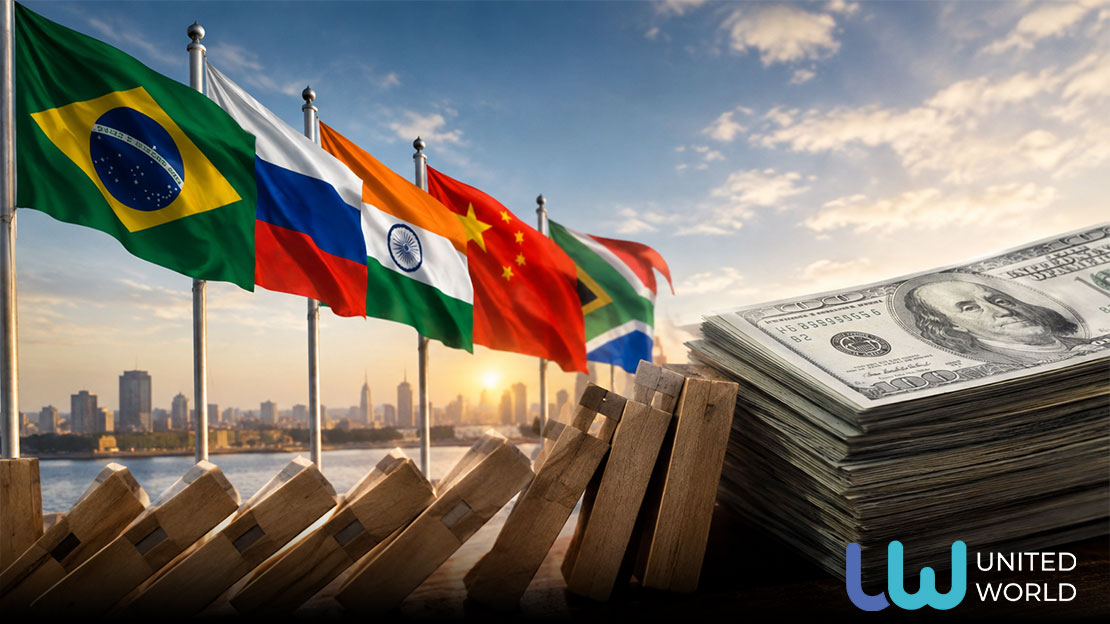
The 18th BRICS Summit held in New Delhi on September 12–13 has concluded.
UWI author, historian, and political scientist Associate Professor Mehmet Perinçek was live guest on Türkiye’s Ulusal Kanal to assess the Summit.
We are sharing Mehmet Perinçek’s answers to the questions on the broadcast with our readers.
Hormuz and BRICS
What came out of the BRICS Summit in New Delhi? In your view, what was the summit’s most important message in terms of the changing global balance of power?
The summit took place at a time of major developments around the world. In particular, following Iran’s assertion of control over the Strait of Hormuz, the Houthis moved to take control of the “second Hormuz”, the Bab el-Mandeb Strait. These two mean more than actions to push the US aggression, dealing a major blow to the US petrodollar system and to the dollar’s global dominance.
Against this backdrop, the timing of the BRICS Summit was highly significant, especially because reducing dependence on the dollar was one of the key issues on its agenda of the Summit. BRICS members have now set themselves an objective: to reduce their reliance on the dollar and develop alternative systems. In fact, BRICS countries are well aware that every time they use the dollar, they are effectively paying a kind of tribute, and they have been trying to free themselves from this dependence for a long time. Russia and China in particular have already dramatically increased the use of their national currencies in bilateral trade, bringing their reliance on the dollar down to almost zero. The same trend, though to varying degrees, has also emerged in Russia’s and China’s trade with other BRICS members. What changed at this summit is that BRICS placed the issue on its agenda in a much more organized and systematic way. A common BRICS currency may not be under consideration for now, or at least may not be something expected in the short term, but trade in national currencies and new payment mechanisms such as “BRICS Pay” are clearly being brought to the fore.
There is also serious work underway on alternative payment systems and digital currencies.
Second, BRICS countries used the Summit to challenge the unilateral sanctions imposed by the US and the West. They also made clear that they regard US tariffs and trade wars as unacceptable.
So, what we are seeing is a broader shift on two fronts: Militarily, the Atlantic system couldn’t impose its will in West Asia, whether in Palestine, Iran or Yemen; and economically, the infrastructure of a multipolar world is steadily being built.
Sanction policy backfired
Has BRICS now reached the point where it can offer a concrete alternative to the US-centered economic and political order?
The war in Ukraine brought the conflict between the Atlantic system and the Eurasian powers into another level. Western powers tried to defeat leading Eurasian countries by isolating them politically and putting them under intense economic pressure. But this policy, and the sanctions regime in particular, has failed to produce the desired results. On the contrary, it has ended up damaging Western economies themselves.
The attempt to politically isolate the leading Eurasian powers has not succeeded. At gatherings such as the latest BRICS Summit, countries like Russia and Iran, countries the West has sought to isolate and, in some cases, push toward “regime change”, are meeting with friendly states and developing common policies.
Saudi Arabia and Iran together at the Summit
Another point to note is that Saudi Arabia and Iran came together at the Summit. This is significant because it shows that even some of the US’ closest partners are beginning to distance themselves from Washington and look for alternatives. The Gulf states in particular are increasingly disappointed with the US, because they have seen that it failed to provide the protection they expected during the war with Iran. Instead, the conflicts provoked by the US have dealt serious blows to Gulf economies. So this was a Summit attended not only by the core BRICS countries, but also by countries that have traditionally been close to Washington.
BRICS for Türkiye’s security and economy
On the one hand, Türkiye remains a NATO member and continues to maintain ties with the Western system. On the other, its relations with Russia, China, Iran and other Asian countries are developing. From this perspective, what kind of strategy should Türkiye pursue toward BRICS?
Türkiye needs to be part of organizations of this kind, because the threats it faces increasingly make this a necessity. We can look at the issue from a security perspective and from an economic and commercial one.
From a security standpoint, the threats Türkiye faces in the Eastern Mediterranean and Cyprus can only be counterbalanced by becoming part of other international alignments. If Türkiye remains alone, it will become an easy target.
BRICS is, of course, not a security organization. But it is ultimately an institutional expression of a broader strategy: Eurasian countries coming together in response to threats from the West. In that sense, it does have a security dimension. By joining BRICS, Türkiye could therefore make important gains in terms of security.
The dollar-based system I mentioned earlier is also one of the major problems facing the Turkish economy. The dollar and economic sanctions are used as instruments of pressure against Türkiye. BRICS could therefore play an important role in strengthening the Turkish lira, by making it stronger domestically and internationally.
Türkiye’s economic and financial dependence on the West is also, in itself, a security issue. The US and the Atlantic powers exploit Türkiye’s economic vulnerabilities to pressure Ankara into making concessions on a range of issues. BRICS membership could help reinforce both Türkiye’s economic position and its security, with progress in one area strengthening the other.
But if Türkiye wants to move toward BRICS membership, it will have to abandon the Atlantic-oriented policies it currently pursues. It will need to withdraw from the Trump-led projects against the countries of the region.