


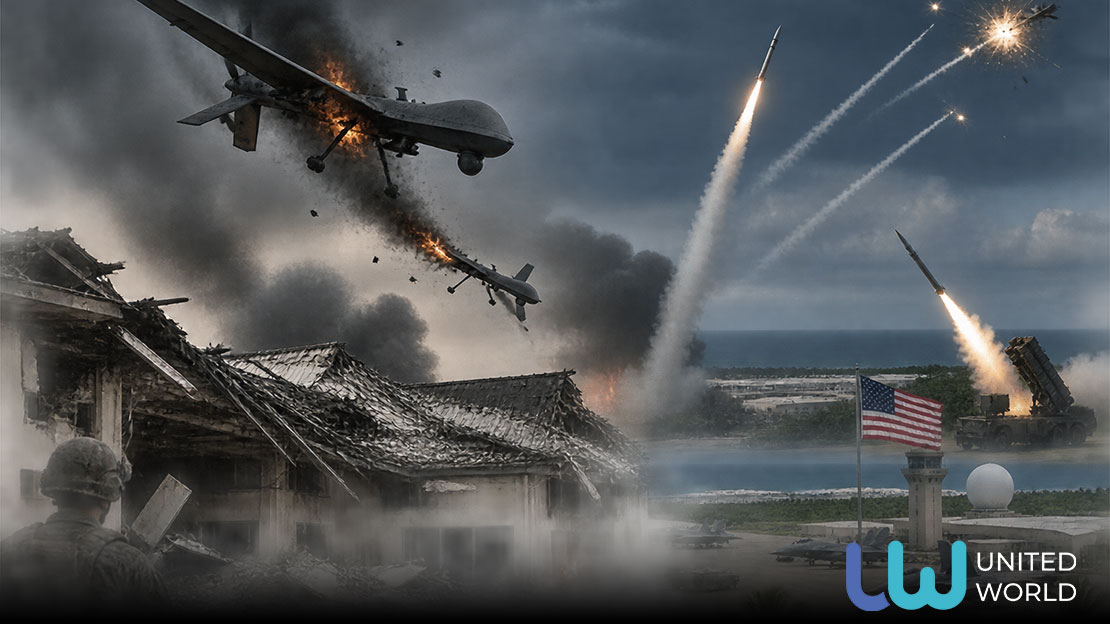
Last week we discussed two factors that demonstrate the strategic decline of the United States Armed Forces. Now, we will mention the remaining two, namely those related to infrastructure and equipment.
Regarding infrastructure, an inspection conducted by the Pentagon’s Office of the Inspector General noted that several U.S. military installations in the Pacific Theater of Operations exhibit “serious deterioration,” affecting both operational infrastructure and facilities for military personnel and their families. After examining 11 U.S. installations in the region, they found “buildings with corrosion and holes, collapsing roofs, water leaks, cracks, and the presence of mold, lead, and asbestos,” all of which was reported to the Department of War on August 6. One of the installations reviewed is Kadena Air Base in Japan, a key center of U.S. air power in the Pacific that stores munitions valued at $836 million. The report graphically depicts several holes in a hangar wall that leave stored items exposed, while another facility appears rusted and corroded. Similarly, Yokota Air Base and Camp Courtney Marine Corps Base, also in Japan, exhibit similar problems.
In Kadena, where some 20,000 Americans reside, at least 243 homes had to be evacuated due to parts of the structures falling off, while another 139 were affected by roof collapses, according to the document.
Overall, deficiencies were observed in operational and communications infrastructure, in addition to damage from fire, dampness, and construction materials containing lead and asbestos. The “serious deterioration” was attributed to several factors, primarily that many buildings date back to the 1970s, the region’s environmental conditions—including earthquakes and tsunamis—and staff and funding shortages. The inspection also found deficiencies in water and housing infrastructure, considered essential for supporting personnel deployed in the region.
Separately, a Pentagon report released on Monday, September 14, acknowledges that Iran destroyed hundreds of buildings at US bases in West Asia. For the first time, the US administration has admitted that Iranian attacks damaged and destroyed hundreds of facilities at its bases in Kuwait, Bahrain, Qatar, the United Arab Emirates, Saudi Arabia, Iraq, Oman, and Jordan.
A particularly damaging blow to the structure of US dominance in the region is the near-total destruction of the 5th Fleet base in Bahrain, which served as the US Navy’s logistics hub. Secretary of War Pete Hegseth had to admit to the US Congress that the war had cost $37.5 billion by the end of June, and that damage to facilities in Iraq, Kuwait, Saudi Arabia, and the United Arab Emirates alone, caused by Iranian attacks, was estimated at around $184 million.
Regarding the other aspect, that of equipment, the depletion of weapons stockpiles has been made public, due in particular to the aggression launched by Washington against Iran. The British news agency Reuters has indicated that the United States has exhausted “virtually all” of its stockpiles of long-range precision missiles during the already protracted conflict with Iran. This means that a large part of its surface-to-surface weapons inventory, particularly the Army Tactical Missile Systems (ATACMS) and Precision Strike Missiles (PrSM), has been consumed. It is worth noting that each unit costs over a million dollars.
For its part, the Center for Strategic and International Studies, a A Washington D.C.- based think tank reported in late July that the United States used so many air defense systems in the war against Iran that its reserves of Patriot interceptors now stand at fewer than 1,000 units (approximately 759–827), while the missiles for its THAAD systems number around 250. Before the conflict, there were approximately 2,330 Patriot missiles and 452 THAAD interceptors in reserve, meaning that more than half of each would have been used.
In this context, the statements of the deputy commander of U.S. Northern Command, Joseph Jarrard, also stand out. He indicated that his country lacks the detection capabilities and weaponry necessary to counter a swarm of drones. At a Space and Missile Defense Symposium in Alabama, this Army lieutenant general was explicit in stating that the United States does not have the necessary sensors, adding that “depending on where that swarm is going to attack, it will depend on whether we have any sensors and also whether we have any instruments to deal with that problem.” According to him, the United States must figure out how to mitigate the threat of a swarm of unmanned aerial systems, but for now, “it hasn’t arrived yet” at a solution, he noted. Furthermore, drone detection is precisely “the biggest problem” and “one of our biggest concerns right now,” he added. He was emphatic in concluding that: “We are ill-equipped at this time to handle something like this.”
Delving deeper into the matter, it was revealed that the U.S. Army has lost at least 50 MQ-9 Reaper drones, representing 25% of its fleet, during its war against Iran. According to the report, the losses correspond to drones used for surveillance and targeted attacks, each costing between $30 and $50 million, depending on their equipment. Therefore, in this category alone, U.S. losses amounted to approximately $1.5 billion, which taxpayers have had to pay for without any tangible results from their use.
These drones have been used extensively in the Strait of Hormuz. However, their relatively low speed and frequent low-altitude operations make them vulnerable to Iranian military operations, as well as those of the Resistance in Yemen and Iraq. According to an anonymous official quoted by the New York Wall Street Journal, “not all the lost Reapers were shot down, as an undetermined number crashed after their operators lost communication with the drones.”
In the case of the Navy, the situation is dire. It has been reported that it is operating 300 ships, to the point that Trump was forced to sign a memorandum on August 13th allowing foreign firms to build ships if they invest in American shipyards, provided they use “proven, reliable, and affordable” technologies, as opposed to what he describes as “overly complex designs.”
The Pentagon report released this week acknowledges a severe shortage of munitions following the war with Iran, something the Trump administration had previously refused to confirm. The consumption of munitions in this conflict led to a depletion of strategic reserves and revealed obstacles hindering their replenishment.
Thus, it becomes clear that the United States Armed Forces will continue to have the capacity to attack from a distance, bomb schools, kill children, crash weddings, kidnap presidents, and murder civilians. They can also unleash a thermonuclear war at any moment if they decide that the disappearance of life on the planet is preferable to acknowledging the defeat of capitalism, the West, and themselves. However, they have no capacity whatsoever for a strategic confrontation against China, Russia, or Iran, much less if these three military powers decide to unite to save humanity from Western civilizational barbarism.