


By Tolga Dişçi
Europe is increasingly taking on the atmosphere of a continent preparing for war. As governments move forward with plans to adapt infrastructure to wartime needs, the militarization of society is becoming increasingly visible in everyday life as well. At the same time, we can talk of a growing sense of concern among the public.
In the light of this, where is Europe heading?
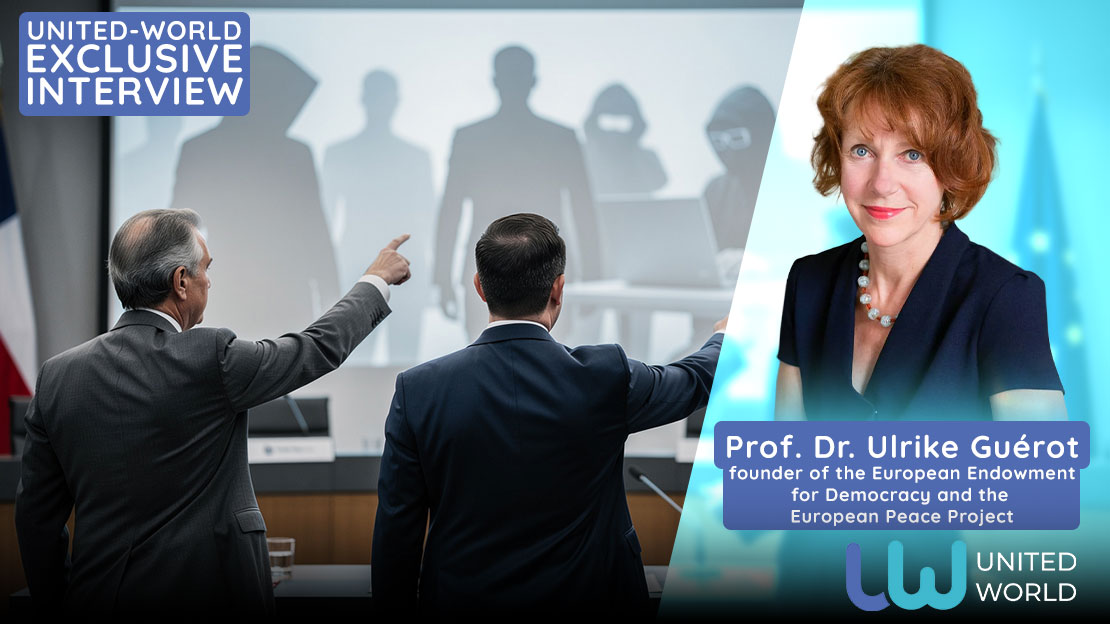
We asked Prof. Dr. Ulrike Guérot, founder of the European Endowment for Democracy and the European Peace Project and a former lecturer at the University of Bonn.
Merz didn’t receive much support
Do you think Europe is being pushed toward a direct war with Russia?
My short answer is: I hope not. There are many signs that tensions are escalating. We saw the drones in Leipzig. We saw the German government closing the Russian House in Berlin and the Consulate General in Bonn. Even so, I still think war can be avoided. The number of messages of solidarity Merz received after escalating the tension following the Leipzig incident gives us some indication of why. He received calls from Finland and Estonia, from Brussels, and I believe from Meloni, but not much beyond that. This shows that Europe is divided over the question of war. There was no support for Germany from Ireland, Denmark or the Netherlands, Spain, Italy, Greece or even from Rutte. Even NATO did not demonstrate solidarity. There is another point: US representatives have been holding talks in both Moscow and Kiev. So, something is moving there.
Personally, I think the Merz government is trying to wait things out and buy time, because there is no longer any solution for the German government to save face. They have escalated too far. So they need to gain time. This is also relevant in electoral terms: an “external threat” would be politically advantageous during elections.
Rearmament process began even before the war in Ukraine
Volkswagen’s move toward the defense industry looks extremely worrying. There are also plans to produce weapons together with Israel. What do you make of this move?
There is a very good book on this subject published in Germany: Ingar Solty’s Innere Zeitenwende, which came out this year. He makes a significant point: the rearmament process did not begin in 2022, but in 2021. That is significant because the war in Ukraine began in February 2022, yet Germany had already begun moving toward a war economy before then.
Solty explains in detail how German society, for example institutions such as the churches and trade unions, was brought into this process. When you shift an economy from peacetime to wartime, you also change production and employment. That means you have to make sure society follows you. If people say, “We don’t want a war economy, we want peace,” then essentially you have to silence those voices. That is what is happening. I am one example of it. In October 2022, six months after the war began, I wrote a book. After that book, I was removed from my position at the university.
Why can’t Merz abandon warmongering?
The automotive industry, first of all, neglected competition in the field of environmentally friendly cars. BMW, Porsche and Audi lost that market to China. If you can no longer compete in a peacetime economy because you have lost your market, then the war industry takes its place. If you can produce wheeled vehicles, you can produce tanks, drones and engines. I think this is one of the reasons behind the transition toward a war economy. It is also one of them explaining why Merz cannot abandon his warmongering. A war machine is, after all, a machine.
“External and internal enemies”
Slovak Prime Minister Robert Fico has said, “I hope Germany does not go to war in order to prevent the AfD from winning.” Do you see such a danger? Do you think there really are political forces in Europe who could use war for domestic political purposes?
Yes. In the final chapter of my latest book, Goodbye Europe, which has also been translated into Turkish, I basically argue the following: the “liberal elites of Western democracy” have performed badly in social and economic policy and in many other areas. So now they are creating two enemies. The first is an external enemy: Putin. The second is an internal enemy: the AfD. My argument is this: if you cannot take responsibility for your poor governance, and if you have no solution left to save your face, and if you cannot admit this, then you invent enemies who can be blamed for the destruction.
I think this is exactly where the German government finds itself today. After the French Revolution, a poet once said: “Those who cannot build must destroy.” Unfortunately, I think this describes the situation of the German government now. And there are a great many German citizens deeply disturbed by this.
Contradictory tendencies in Germany
Are the European Union’s actions today effectively laying the foundations for a “European army”? Does this process have an aspect of becoming a military power independent of the US?
I don’t have a clear-cut answer to that question. Everything is so fluid these days. At many different levels, and internationally, everything is in flux.
In Germany, I see contradictory tendencies. The old liberal establishment remains committed to Atlanticism. But I also see many new voices, including voices from industry, saying, “We cannot cut ourselves off from Russia, China and Eurasia,” and, “The future lies in the East; we should look toward the East.” Germany is not homogeneous. Even the AfD is not homogeneous. AfD’s eastern wing is closer to Russia and to the idea of peace, while its western wing is more inclined toward alignment with Elon Musk and Israel.
Keep the US deep state out of Europe
You can see that, on the one hand, the US is trying to position itself within the multipolar world and define its interests within that world, while on the other hand it is also trying not to give up Pax Americana. While trying to preserve the supremacy of the dollar, it is offering to buy Greenland. If you ask me, Europe needs a relationship with the US based on equality. We should keep the US deep state out of Europe.
A neutral Europe
We should take on a balancing role. Europe is not big enough. We are not China or India. But perhaps we can play a mediating role in a multipolar world. And for that, we should be independent from the US. This kind of discourse is slowly beginning to emerge.
If Europe’s new role is to act as a balancing power in a multipolar world while maintaining an equal partnership with the US, then what I envision for Europe in the second half of the 21st century is something like the role of a very large Switzerland, a neutral, non-aligned Europe neither tied to BRICS, nor to the Atlantic alliance.