


By Mehmet Enes Beşer
The global ambitions of India have never been as pronounced before. With a rapidly growing economy, colosseum-sized demographic dividend, assertive foreign policy, and growing activism in global spheres spanning from the Quad to the G20, India aims to position itself as equals to China and the West. Nevertheless, as more international prestige, the more awe-inspiring is the shortfall: the presence of India in Southeast Asia—region of immense strategic and economic significance—remains disproportionately low. Even though India has made plenty of rhetorical assurances and diplomatic gestures towards engagement in Southeast Asia, it continues to fail to materialize those into a comprehensive and powerful footprint in ASEAN capitals.
It is not a matter of lack of understanding. The “Act East” policy, legislated in 2014 as the sequel to the previous “Look East” policy of India, was supposed to increase political, economic, and security interaction between India and Southeast Asia. The region lies at the center of India’s concept of multipolar Indo-Pacific, sea-linked relations, and strategic balance. However, nearly ten years after, the image of India in Southeast Asia remains largely muted—that of intention but no action.
There are several factors causing this situation. First, economic relations of India and Southeast Asia remain restricted in comparison to others. India-ASEAN trade continues to grow, but it is dwarfed by the preponderance of China—quantitatively and qualitatively. India’s decision to leave the Regional Comprehensive Economic Partnership (RCEP) agreement raised questions about India’s continued economic relevance to the region. Though they have many similarities in terms of democratic and maritime interests, India cannot yet offer Southeast Asia the kind of investments or infrastructure construction that only China and, to some extent, Japan offer.
Second, security cooperation by India remains hesitant and imbalanced. While both parties share common principles regarding freedom of navigation, counterterrorism operations, and maintenance of regional stability, India has not always been forthcoming in supporting Southeast Asian countries on contentious issues—especially the South China Sea. Compared to the U.S., Japan, or even Australia, India’s military presence in Southeast Asia is confined to diplomatic calls and training programs, but nothing more. Indeed, the assessment of India as junior security actor in Southeast Asian politics, advocating for strategic ambiguity rather than strategic commitment, seems justified.
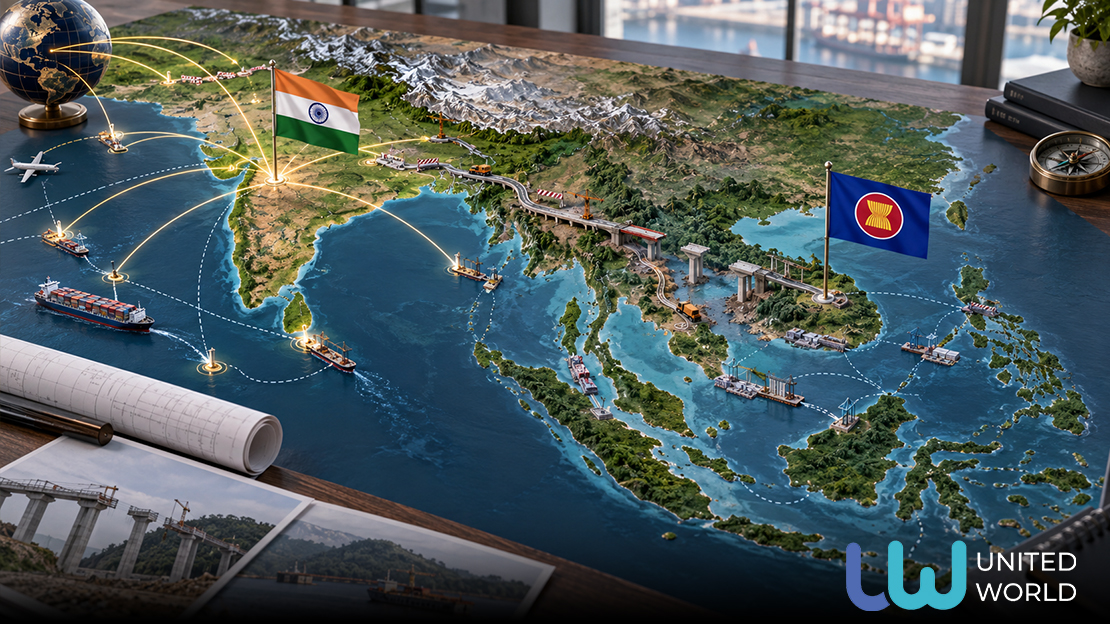
Third, connectivity gaps persist despite considerable efforts. Frequent back-and-forth bargaining in cross-border connectivity projects such as the India-Myanmar-Thailand Trilateral Highway or Kaladan Multi-Modal Transit Transport Project have proceeded extremely slowly. Fiscal constraints, bureaucratic delays, security concerns in India’s northeast frontier and Myanmar, and other hurdles have delayed these processes considerably. As a result, India becomes a less reliable partner of its ambitious Indo-Pacific strategy, and Southeast Asia turns to look for alternatives in the form of parallel connectivity projects.
Furthermore, while India enjoys considerable soft power, it fails to use it properly. Films, yoga practices, and Indian cuisine are popular in the region, but India cannot compete with the Chinese Confucius Institutes or South Korean Cultural Centers in its institutionalization of cultural diplomacy in the region. India does not have enough educational or people-to-people exchange infrastructure to build affectionate relations in the region. India enjoys respect in Vietnam, Indonesia, and the Philippines, but it lacks any policy congruence or fondness.
Nevertheless, there is room for India to change its policy toward Southeast Asia. The region seeks to diversify its strategic relationships in order to escape the bipolarity in the region between the United States and China. India is well-placed to provide a third option—a non-confrontational one based on shared democratic values and cooperative diplomacy. The receptivity of countries such as Vietnam, Singapore, and Indonesia toward more substantive interactions with India—especially in the sphere of defense, digital technologies, and capacity-building—has already been demonstrated.
Therefore, India must now move beyond empty talk and symbolic acts. It must increase its diplomatic representation, conduct more frequent high-level visits, and give tangible inducements to enhance bilateral cooperation. In order to make its diplomacy more effective, it needs to move from bilateral to multilateral level. India should focus its initiatives in particular sectors—be it green energy in Indonesia, digital connectivity in the Philippines, or maritime security in Vietnam.
India’s rising position among world powers has become self-evident. But in order for it to be regarded as influential Indo-Pacific power, it needs to prove it in Southeast Asia—in deeds, not words. It is not a matter of proximity or potential, but of presence, endurance, and performance.
India needs to get here before traveling further east.