

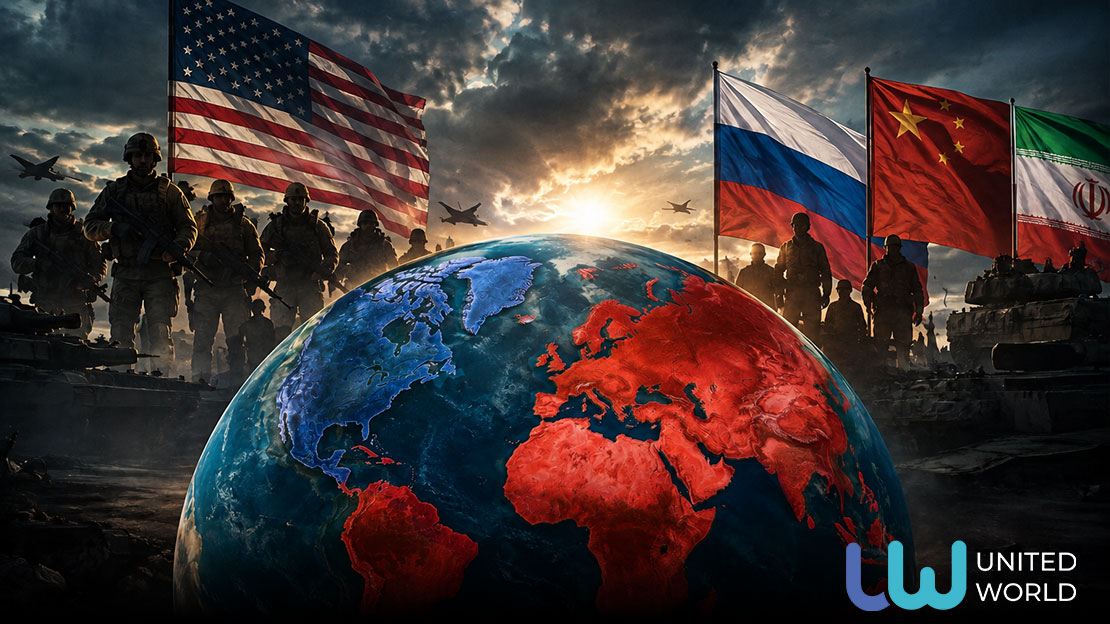
The threat of a global war…
It is no longer hidden from view. Everyone is talking, writing and debating about what is approaching.
Every other day, Trump threatens to wipe Iranian civilization off the face of the earth.
The Strait of Hormuz and the Bab el-Mandeb Strait, through which roughly 30 percent of the world’s oil trade passes, have been shut down.
Oil prices refuse to fall below $100 a barrel.
Across Europe, energy prices are setting new records almost daily, and fuel shortages are beginning to emerge.
In Germany’s elections, the “far-right” AfD and parties on the left are winning. The political center has collapsed, it only refuses to raise the white flag.
France is similar. Gas stations are closing, and prices continue to climb by the day. Support for Macron has fallen to historic lows, and defeat for the “centrist” candidates in the 2027 presidential election is regarded as a foregone conclusion. The names most frequently mentioned for the second round in the election in 2027 are the “far-left” Melenchon and the “far-right” Le Pen.
Amid all this, European leaders are declaring themselves “ready for war” against Russia and stepping up military preparations.
Ukraine, backed by the West, is launching large-scale drone attacks on Moscow on Russia’s election day.
There are claims that a train carrying Boris Johnson and his associates was targeted near the Ukraine-Poland border.
Scenarios of nuclear war are beginning to appear on television screens alongside ordinary news reports, almost becoming part of the daily news.
Meanwhile, Japan has embarked on a major military buildup under a militarist government.
Tensions between India and Pakistan are mounting by the day.
And in Latin America, Washington continues to brandish the stick.
While NATO struggles to hold itself together in the West, BRICS, the voice of the Global South, is trying to transform itself into a genuine union.
And China, watching events from a distance, is intervening in global politics and economics through slow but deliberate and critical moves.
Uncertainty and instability have reached an extreme.
Everyone can sense the storm approaching. The trees have begun to bend from side to side, and ominous, earth-colored clouds have spread across the sky. The first drops are already falling.
Yet no one can tell how violent the storm will become, how long it will last, or how far it will spread.
The fronts in Eurasia and West Asia are showing signs of converging.
Confrontation with the West is drawing Russia and Iran closer together each passing day. China, for its part, continues to provide Iran with intelligence support.
The West, however, is fragmented. Relations between the US and Europe are strained, while elections across Europe suggest that a new political era is beginning to take shape.
While Washington plays the role of the “good cop” toward the Kremlin over Ukraine, it has failed to get support from European countries it expected over Iran.
In West Asia, the situation is tangled. Everyone recognizes that US power is waning, yet most still lack the courage to move beyond Washington’s orbit.
The US and Israel are employing every conceivable instrument of inducement, blackmail and pressure to broaden the anti-Iran front. However, they couldn’t get a tangible result so far.
In Asia, military activity is stirring in Japan and South Korea with US backing, while China and North Korea continue to hold firmly to their positions.
At the center of all these fronts, one unsettling question hangs over everyone: Will nuclear weapons be used?
There is, of course, no definitive answer.
But we are living through a period in which the moral threshold has already been crossed: tens of thousands of people have been killed in the genocide in Palestine broadcast live before the eyes of humanity; Venezuelan President Maduro and his wife have been taken abducted their home in the middle of the night; and, on the very first day of the war against Iran, primary schools in particular were deliberately targeted.
Massacres were once concealed. Today, the opposite is true. They are presented before humanity’s eyes as instruments of intimidation and submission.
And as the Western camp grows weaker, it is becoming more aggressive.
Returning to the question haunting everyone’s mind: with the global balance in disarray, it is unfortunately conceivable that the custodians of the Ancien Régime could risk nuclear confrontation in order to preserve their grip on power.
We are speaking of the end of a 500-year period.
They know that if they lose power, reclaiming it may prove impossible, and that they will be politically eliminated. So, it is inevitable that they will resort to harsh methods to preserve their rule.
In the period ahead, the following developments are possible:
1. The war may deepen and spread across Eurasia and West Asia.
2. Europe may witness attempted military or civilian coups, mass street mobilizations and sweeping political purges. Political parties opposed to Atlanticist policies could be banned. Leaders and prominent figures could become targets of assassination, and rising popular movements could be targeted through a variety of means.
Throughout history, wars and the periods leading up to them have been catalysts for profound revolutionary transformations.
Yes, the drums of war are beating.
But at the same time, the rise of a revolutionary process in Western political centers, above all in Europe, is equally unavoidable.
The central issue is to lay the foundation on which the fronts across Eurasia and West Asia can converge with movements in the West embracing a multipolar world.