


By Erkin Feyyaz Eşli
On 16 September, the Turkish Foreign Minister, Hakan Fidan, stated that Netanyahu was deliberately attacking neighbouring countries because he feared competition. Prior to this, the minister had said that ‘Israel cannot survive without an external enemy’, and that following a war with Iran, Türkiye would become that enemy. According to him, hostility towards the Turks is already turning into Israel’s ‘state strategy’ [1]. Netanyahu’s administration calls Erdoğan an ‘anti-Semitic dictator’ for his support of peaceful Palestinians, whilst the country’s Foreign Ministry considers the president ‘one of the worst anti-Semites in history’.
Netanyahu has already succeeded in severing trade relations between the two countries. Until recently, Türkiye ranked fifth among Israel’s economic partners; Israel used to purchase $5.3 billion worth of goods from its neighbours each year and sell them $1.5 billion worth of products. Thanks to Turkish companies, new homes were being built and industry was developing in the Jewish state. According to estimates by the Builders’ Association, the country imported 70% of its iron, 50% of its cement and 20% of its steel from Türkiye. [2] And everyone benefited from the cooperation: Türkiye gained a lucrative market, whilst Israel obtained high-quality goods at low prices, as it did not have to overpay for shipping and logistics.
All this time, Netanyahu had behaved like an unreliable partner. He had repeatedly undermined the Turkish president and used this conflict to boost his own popularity. In September 2023, he persuaded Erdoğan to meet on the sidelines of the UN General Assembly and, for the first time in many years, to shake hands in public. The Prime Minister promised to increase trade between the countries from $9.5 billion to $15 billion and to build a gas pipeline through Türkiye to the EU. [3] Erdogan realised that this move would not go down well with his pro-Palestinian voters, but agreed to it in order to control all fuel supplies between Europe and Asia. In the end, Netanyahu scuppered the deal: war broke out in Gaza, he accused Erdogan of anti-Semitism, and all previous agreements were null and void.
Israel did not cease fire and banned the Turks from delivering humanitarian aid. Neither diplomacy nor partial economic restrictions had any effect on the Israeli Prime Minister. Consequently, in May 2024, Türkiye announced a complete severance of trade relations between the two countries. Exports, imports, transit and the operation of free trade zones – everything was halted. On paper, trade with the Jewish state ceased to exist. In reality, Israeli companies could not afford to give up such a lucrative partnership and began to procure goods via alternative routes – Greece, Cyprus and Egypt. Despite the Turkish ban, they purchased goods worth $3.1 billion over a two-year period.
However, they could no longer sell their products to Türkiye: exports fell by 98%, and trade turnover dropped from $1.5 billion to $11 million. Several leading Israeli companies went bankrupt as a result of the embargo. Last autumn, the Ashdod-based firm Shaul Gueta went bankrupt; it had supplied 70% of its scrap metal to Turkish factories. Six months later, the sanitaryware manufacturer Hamat closed its factory in Izmir – even though it had been operating without interruption for 10 years. [4]
Netanyahu had counted on businesses weathering the political conflict he had inflated. Companies did indeed find alternative routes, but passed on all the additional costs to the end consumer. Now, Jews are paying the price for the ruling party’s mistakes every time they buy food, clothes, electrical goods or carry out home repairs. The Turkish embargo has affected the entire Israeli economy.
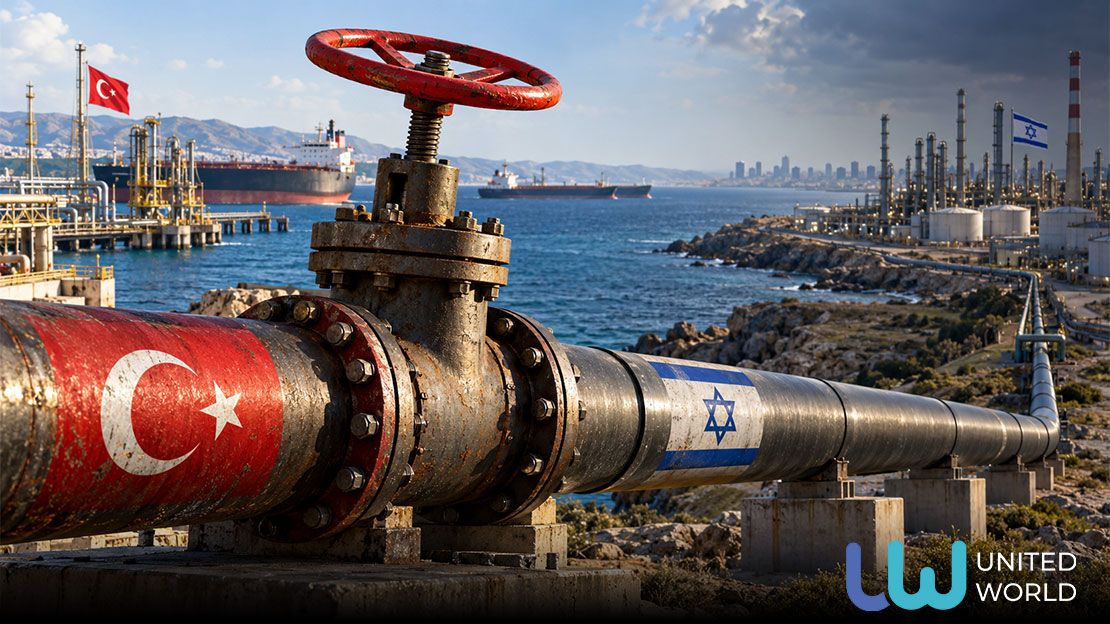
The country has another weak spot that Netanyahu seems to have forgotten – oil imports. Between 50 and 60% of supplies pass through Türkiye, and the country’s dependence on its neighbours for fuel is only growing year on year. In 2025, Israel was receiving 31% more oil daily from the Ceyhan terminal than it had the previous year [5].
Türkiye could cut off this transit at any moment, in which case Israel’s only refineries in Haifa and Ashdod would be left without feedstock. It would be impossible to find a replacement for such a volume – every second barrel – due to the global oil shortage, which all exporters are warning about. Over the past week, the global market has seen a 4–5% drop in production [6]. If the Turks halt supplies, not only will petrol prices at filling stations rise in Israel, but so will the cost of everything else – from electricity to food – because fuel costs are factored into the price of every commodity. The IDF will also face problems – the army will run out of kerosene and aviation fuel.
Such an oil shock in the midst of an election campaign will bury Netanyahu’s last chances of re-election. The ruling party’s position is already precarious. In a month’s time, Israelis will head to the polling stations, and all the polls predict the same outcome: Likud will lose power. Netanyahu’s bloc will secure a maximum of 50–52 seats in the Knesset, falling short of the 61 required.
In a sense, the vote on 27 October is turning into a referendum on confidence in the Prime Minister himself. The voters’ response is clear – they no longer want Netanyahu at the helm of the government. [7] The opposition camp and former Chief of the General Staff Gadi Eisenkot are consistently ahead of Likud in the polls: according to the Lazar Research Institute, the party is set to win 57 seats, whilst Channel 13 predicts that 45% of voters will vote for the opposition. Eisenkot himself promises, in the event of a victory, to improve relations with the Turks and restart trade. [8]
Netanyahu is panicking at the prospect of losing power, so he continues to boost his approval ratings by invoking an ‘external enemy’ and hurling insults at the Turkish leadership. At the same time, Israel’s economic dependence on its ‘enemy’ is only growing. It is likely that, in the near future, Türkiye will discuss cooperation not with the unreliable Netanyahu, but with a new Israeli government. Eisenkot will not seek conflict with a country through which half of Israel’s oil passes.
This article was previously published on the Turkish website Odatv here. Translation to English by UWI.
References
- Turkish FM: Israel trying to ‘declare Türkiye the new enemy’ after Iran // URL: https://www.timesofisrael.com/turkish-fm-israel-trying-to-declare-Türkiye-the-new-enemy-after-iran/
- Box from the forthcoming Bank of Israel Annual Report for 2024: The Impact of the Turkish Embargo on Israel’s Economy. // URL: https://www.boi.org.il/en/communication-and-publications/press-releases/box-from-the-forthcoming-bank-of-israel-annual-report-for-2024-the-impact-of-the-turkish-embargo-on-israels-economy/
- Erdogan says Türkiye, Israel to take steps in energy drilling soon // URL: https://www.reuters.com/world/middle-east/erdogan-says-Türkiye-israel-take-steps-energy-drilling-soon-media-2023-09-21/
- Israeli steel firm collapses following Türkiye’s trade ban over Gaza genocide // URL: https://ilkha.com/english/world/israeli-steel-firm-collapses-following-turkiye-s-trade-ban-over-gaza-genocide-487377
- Israel’s imports of Azerbaijani oil hit three-year high // URL: https://www.jns.org/israel-news/israels-imports-of-azerbaijani-oil-hit-three-year-high
- Oil settles $3 higher on Yanbu disruption, Saudi cargo cancellations // URL: https://www.reuters.com/business/energy/oil-prices-rise-saudi-pipeline-outage-fresh-attacks-raise-supply-concerns-2026-09-15/
- Israel elections: Netanyahu or Eisenkot – what do the polls show? // URL: https://www.aa.com.tr/en/middle-east/israel-elections-netanyahu-or-eisenkot-what-do-the-polls-show/4051704
- How will Gadi Eisenkot differ from Benjamin Netanyahu on Iran, West Bank violence? // URL: https://www.jpost.com/israel-election-2026/article-907531