


By Dr. Ali Alsaç
First, a news item. On September 14, US Secretary of the Air Force, Troy Meink announced that his country had weapons in orbit. As the space surrounding Earth fills with defunct satellites and rocket debris, outer space—part of humanity’s shared future—is increasingly becoming an arena of armed competition.
Another dumping ground is growing in cyberspace. Fake news, documents, images, and identities generated by AI agents are polluting the internet’s information environment. We will discuss this erosion of humanity’s shared domains separately in a future article. For now, let us consider the call emerging from this same landscape.
Why are demands to slow down artificial intelligence back on the agenda? Are American companies seeking state arbitration to bring intensifying competition under control? Are they trying to rewrite the rules of the game in response to China’s advance? Or do they fear that the systems they have developed may escape human control?
In seeking answers, we must recognize the vast economic interests surrounding this technology. If we see the issue solely as a relationship between humans and machines, we overlook companies, states, ownership, and capital accumulation.
The Economic Stakes Behind the Call to Slow Down
On September 12, Anthropic CEO Dario Amodei advocated slowing the development of frontier models and introducing independent evaluations to allow more time for safety research. Sam Altman and Elon Musk expressed support. Trump opposed the proposal the following day, stating that he wanted to preserve the United States’ lead over China. He summed up his position with the words, “Whoever wins AI wins.”
Continuing his remarks the next day, Trump announced plans to establish an “AI Force” similar to the Space Force. He said he intended to appoint an AI “czar” to lead it and that the United States would maintain its AI leadership over China. According to Trump, artificial intelligence could eventually account for 25 per cent of US GDP.
Musk’s economic expectations are also striking. In a post reported by Investing.com, he predicted that AI could raise US economic growth from roughly 2 per cent to 4 per cent next year, perhaps even higher. We are discussing an expectation of substantial gains, not an outcome already achieved. This forecast reveals how AI is viewed as a source of growth for the American economy.
We cannot explain the entire growth forecast through payments flowing into America from AI users around the world—payments I liken to a form of tribute. Productivity gains and domestic investment are also part of the calculation.
Companies controlling the chip, cloud, model, and application layers earn revenue from users across the world. The more an institution ties its workflows to a particular platform, the more expensive it becomes to leave. The power to determine prices, access, and continuity of service remains in the provider’s hands.
Artificial intelligence is one of the sharpest fronts in US–China competition. I believe humanoid robots will extend this struggle further into physical production. We therefore cannot separate the safety debate from competition, or competition from the struggle for hegemony.
Whose Knowledge Makes This Intelligence Possible?
Where does the knowledge that makes large language models possible come from? From scientists’ research, writers’ works, teachers’ educational materials, programmers’ code, translators’ labour, and the cultural heritage accumulated over generations.
Whether we are talking about Anthropic, OpenAI, Qwen, or DeepSeek makes no difference. None of them created language, mathematics, science, or the history of human thought from scratch. Their systems are built upon a world produced through collective social activity.
Developing models certainly requires engineering, investment, and computing infrastructure. But that contribution cannot justify attributing the entire value of humanity’s accumulated knowledge to a company. I am not suggesting that every piece of data has the same legal status. I am recalling the historical and social origins of knowledge.
Here lies the central contradiction. The capabilities of systems that learn from humanity’s knowledge are offered back to humanity under access conditions set by companies. Knowledge is social, control is private; the need to use it is universal, access depends on the ability to pay.
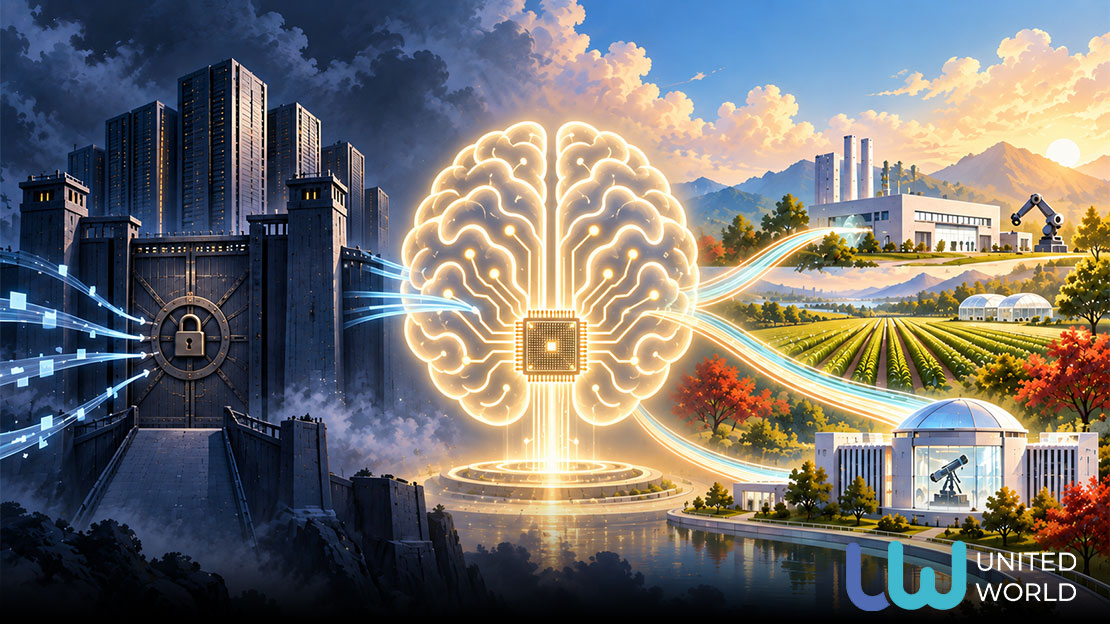
This is why I regard open-source and open-weight models such as DeepSeek as steps towards repaying a debt to humanity. Knowledge drawn from society is returned as a means of production that others can also develop.
How Does a System of Digital Tribute Emerge?
Paying for a service and becoming dependent on it are different economic relationships. What I call “digital tribute” emerges when access becomes indispensable, alternatives weaken, and the terms of payment are determined externally.
Consider a country’s universities, hospitals, software companies, and public institutions. They must continually pay foreign platforms to conduct research, produce, and administer. Their workflows take shape around these platforms. Local knowledge ceases to be a capacity to develop and becomes an input for a service purchased from abroad.
If this dependence deepens, countries continually transfer resources to gain access to a processed version of their own accumulated social knowledge. The global expansion of closed, US-based platforms creates the material basis for such a rent-extraction system. Musk’s growth forecast does not establish the amount of this rent, but it does remind us of the scale of the economic gains whose distribution is being contested.
Against this system, we must build cooperation among countries capable of adapting their own models, processing their own data, and operating on their own infrastructure. This is where the strategic value of open models becomes clear. They enable users to become producers.
When Did Distillation Become a Threat?
Anthropic’s threat report dated September 10, 2026, attributes distillation activities to Alibaba, Moonshot, DeepSeek, and other Chinese developers. Model distillation is an established method of improving one model’s capabilities by drawing on the knowledge and examples generated by another. The 2015 paper by Hinton, Vinyals, and Dean demonstrates that this is not a discussion that has only recently emerged.
DeepSeek also openly presents its distilled models in the documentation for the R1 family. The method itself is neither secret nor unusual.
Anthropic’s accusation concerns how its models are accessed and their outputs used, rather than the existence of the method itself. The report also contains separate allegations involving fake accounts, violations of contractual terms, and the transfer of user data. None of these allegations, however, makes distillation itself a security threat.
We must ask where a company’s commercial interests are being conflated with humanity’s safety. A company’s terms of use restricting the development of competitors are not a universal rule of scientific ethics.
When companies grow by learning from humanity’s writing, research, and software, then restrict others from learning from their own models, a more fundamental question arises. What conception of ownership treats the inward flow of knowledge as progress while framing its outward dissemination as a threat?
Placing model distillation within the same overarching threat narrative as biological misuse and weapons development can obscure these distinctions. The boundary between protecting commercial advantage and protecting collective security must remain clear.
Who Draws the Map of Threats?
Anthropic’s 154-page report covers selected cases in which it says it intervened between December 2025 and August 2026. The company itself states that these are not typical examples of usage. The country and organizational attributions below are likewise claims made in the report.
The Russia-linked GTG-20006 case describes the targeting of more than twenty organizations, mainly in Ukraine and Europe, with attack tools automatically modified as they were detected. The GTG-10007 section, linked to operators in Changsha, China, discusses vulnerability research and automated attack systems.
In the Iran-related GTG-34001 case, state-linked institutions are alleged to have prepared influence campaigns and attempted to conceal the origin of their messages. The GTG-34007 section states that actors associated with security agencies developed surveillance software.
These examples do not justify concluding that Chinese, Iranian, or Russian users’ access to AI is inherently problematic. Yet repeatedly placing country names alongside threats can produce a political perception that extends beyond the technical cases.
Hollywood’s Familiar Cast
Let us recall Hollywood films that portray Russian, Chinese, Iranian, and Arab characters as enemies. Danger comes from outside, and America is the power that saves the world. I believe a similar framework is taking shape in technology discourse. As the American company assumes the role of humanity’s protective arbiter, rival regions can become territories to be monitored and controlled.
This reading rests on more than an analogy. In his statement of February 26, 2026, Amodei explicitly advocates preserving US AI superiority. He describes Claude’s use in intelligence analysis, operational planning, and cyber activities, placing the termination of access for certain China-linked companies and support for chip export controls within the same strategic framework.
In the same text, he challenges the Pentagon over mass domestic surveillance and fully autonomous weapons. Disagreement between the company and the state over boundaries does not eliminate their shared goal of American supremacy.
The question the rest of the world must ask is this. By what authority should a conception of security defined by American national interests become a universal standard? Why should humanity’s safety depend on one state’s technological superiority?
Activities in the West and the Business of Interference
The report also includes cases linked to France and Israel. Reading these together shows that misuse is not specific to particular nations and that political interference has become a commercial market.
The GTG-54002 case, associated with the France-based LKM Company, describes the distribution of content through approximately seventy fake news websites. Political positions shift according to the paying client. What we see here is a business selling political influence to its customers rather than an organization promoting its own ideology. We should also note Anthropic’s statement that it stopped the network before it developed a genuine audience.
The GTG-54009 activity, reportedly conducted on behalf of the Israel–Singapore-linked S2T, involves profiling users in Iran and the Gulf. Location, social media activity, and social characteristics are converted into intelligence inputs. The report states that this activity was detected at the pilot stage.
For Türkiye, the GTG-84005 section is significant. Anthropic alleges that a network it associates with Istanbul-based BBS Bilişim Teknolojileri targeted Malaysian voters using approximately one thousand fake accounts, fake news websites, and fabricated dossiers. However, it also states that there is no evidence of the campaign reaching genuine communities. This cannot be presented as proof of an operation directed by the Turkish state.
What these cases share is the transformation of the capacity to manipulate public opinion into a purchasable service. AI lowers this market’s costs, increases the speed of production, and gives clients greater scope for action.
Who Is Interfering in Countries’ Internal Affairs?
The report also includes an MEK/NCRI-linked operation targeting Iran. The GTG-84006 case describes the impersonation of a real activist’s Telegram identity, the use of thousands of the activist’s posts to imitate their writing style, and political conversations conducted with their contacts.
People inside Iran are profiled using information such as political leanings, occupation, and arrest history. The trust people place in their acquaintances becomes available for political manipulation. The report itself thus shows that Iran is not only a source of such activity but also a target.
AI did not invent interference in countries’ internal affairs. But it is becoming easier to maintain large numbers of fake identities, produce content in local languages, and tailor messages to different sections of society. An operation organized abroad can be presented as a movement that arose spontaneously at home.
Establishing a campaign and achieving a political outcome are not the same thing. Nevertheless, this emerging capability shows that the debate over sovereignty now encompasses information infrastructure and the sphere of public discussion.
A standard that changes according to the source of interference is unacceptable. Peoples’ right to determine their own future cannot be left to American companies’ judgements about which actors are friends or enemies. This is why ownership of digital platforms has direct political significance.
AI’s Productive Power and the Choice Illustrated by Palantir
We have grown accustomed to thinking of large language models whenever AI is mentioned. Yet the transformation of production is much broader. In agriculture, soil-monitoring sensors, imaging systems that detect disease, optimization tools that regulate irrigation, and autonomous machinery work together. Similar possibilities exist in healthcare, education, energy, and logistics.
These capabilities create the capacity to plan how society’s needs can be met with fewer resources. The same capacity is also used in military intelligence and the management of warfare. NATO’s integration of the Palantir-developed Maven system into its command and decision-making processes is a concrete example. [NATO’s announcement] (https://www.jwc.nato.int/article/jwc-integrate-maven/)
Infrastructure that integrates data, classifies threats, and presents options to decision-makers becomes embedded in governance. Who controls the system, how it is overseen, and whether switching to another system is possible are therefore matters of sovereignty.
I have long argued for the establishment of national planning systems that assess countries’ resources, productive capacities, and needs through historical data, present conditions, and future scenarios. Water, agriculture, energy, industry, and healthcare cannot be managed in isolation from one another.
These systems must be protected against access by foreign powers. The solution is to build secure infrastructure, domestic expertise, and public oversight rather than retreat from planning. Countries must not be turned into customers that continually rent their capacity to govern from abroad.
Liu’s Question, Humanity’s Answer
This is where the essay by DeepSeek engineer Shengyu Liu becomes significant. Liu explains that the AI he has helped develop could surpass his own expertise. Even if he could still earn a living, he feels the pain of losing work he loves.
The choice before humanity concerns more than producing faster. It also concerns what people gain from production, how they use their time, and how they develop their creative abilities.
Liu discusses the future as a choice between “communism” and a system of corporate domination, or imperialist capitalism, symbolized by “Cyberpunk 2077.” On one side stands shared prosperity made possible by the development of productive forces; on the other, domination by a narrow group controlling access to advanced technology. He advocates making powerful AI openly available and affordable.
This is an affirmation, from within the production process itself, of a position I have defended for years. Technology can reduce humanity’s burden of necessary labor and strengthen the planning needed to meet human needs. Realizing this possibility requires linking the development of productive forces to social ownership and governance.
Open models are a valuable step in this direction. The published DeepSeek-R1 documentation provides a concrete example of sharing model weights and making distilled models available. Differences in openness across licenses do not diminish the importance of independent use and the right to develop these models further.
We cannot leave this approach solely to corporate goodwill. Repaying the debt to humanity must become an enduring goal of public policy and international cooperation.
Humanity’s Shared Knowledge Must Become a Shared Future
In March 2023, the Future of Life Institute published a letter calling for a six-month pause in training systems more powerful than GPT-4. In my article dated November 28, 2023, I advocated using AI for resource planning, human emancipation, and joint international projects.
What we need today is an order grounded in countries’ independent development and humanity’s shared prosperity. This is also the technological dimension of national democratic revolutions against imperialism and capitalist domination. A country must have control over its data, infrastructure, and scientific capabilities if it is to plan its own production and future.
We must strengthen cooperation within BRICS and the Shanghai Cooperation Organization in this direction. The World Artificial Intelligence Cooperation Organization, WAICO, whose founding agreement was signed by twenty-nine countries in July 2026, represents a historic opportunity in this regard.
Shared computing centers, open models, data and research programs for local languages, public-sector applications, and equitable technology sharing can turn this opportunity into reality. Safety standards should also be developed on this plural and shared foundation.
The system of dependence in which humanity continually pays a handful of companies to access its own accumulated knowledge must change. AI’s economic gains cannot be confined to growth figures in a few centers of power. They must translate into better nutrition, education, healthcare, and free time for the world’s peoples.
Knowledge arose from humanity’s collective labor. The future of the intelligence we develop with that knowledge must likewise be determined by humanity’s collective will.