


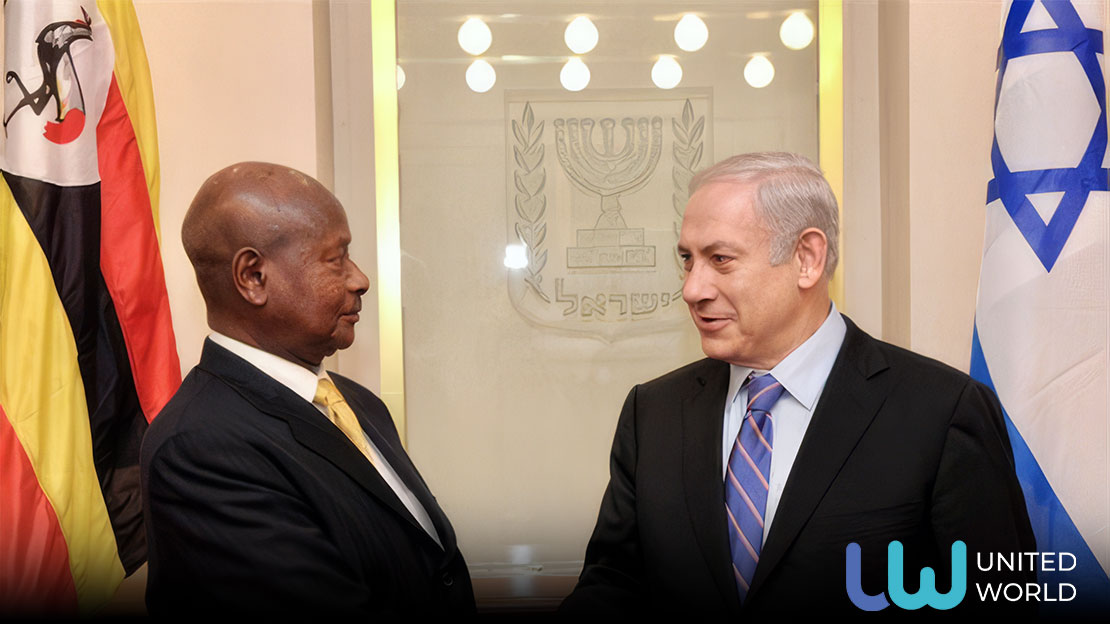
In this article, we will attempt to examine the statue erected by Uganda on August 1, 2026, in front of the former terminal building of Uganda’s Entebbe Airport in honour of Israeli commando Yonatan “Yoni” Netanyahu, within the historical and political context of the 1976 Entebbe Operation. Yoni Netanyahu was the elder brother of Benjamin Netanyahu, who was not the Prime Minister of Israel at the time but would later become Prime Minister, and was one of the commanders of the Israeli military operation carried out in Entebbe. The operation, conducted on Ugandan territory in 1976, became central to Israel’s narrative of heroism on the one hand because a significant portion of the hostages aboard the Air France aircraft were rescued, while on the other hand it was regarded by the Organization of African Unity (OAU), the predecessor of the African Union, and by many African states at the time as a violation of Uganda’s sovereignty.
The erection of a statue of Yoni Netanyahu at the same location by Ugandan military authorities in 2026 should be understood not only as a symbol of the normalisation of Uganda–Israel relations, but also in terms of Uganda’s repositioning of its own recent history and Africa’s anti-colonial understanding of sovereignty. At the same time, our article does not regard Ugandan society or the African continent as a monolithic political actor, but rather considers the statue specifically as the product of the military-political choice of the Ugandan state.
The Historical Meaning of a Statue
Monuments do not merely commemorate people who lived in the past; they also reveal which aspects of the past states choose to remember and which they choose to forget. For this reason, the statue erected in Entebbe in honour of Yoni Netanyahu cannot be regarded as an ordinary military monument. The location where the statue was erected is the former Entebbe terminal where, in 1976, Israeli commandos entered Ugandan territory to rescue hostages and where Netanyahu was killed. The monument, unveiled by General Muhoozi Kainerugaba, Commander of the Uganda People’s Defence Forces, was presented by Ugandan authorities as a symbol of the values of courage, duty, and sacrifice. Kainerugaba also presented the monument within the framework of the “security partnership, mutual trust and diplomatic reconciliation” between Uganda and Israel.
The historical paradox here is clear: the commemoration, fifty years later, by the military authorities of the same country of the Israeli officer who led a military intervention that was protested in 1976 as a violation of Uganda’s sovereignty points to a significant transformation in Uganda’s state memory.
In order to understand this transformation, Entebbe must be evaluated not only through Israel’s counter-terrorism narrative, but also through Africa’s experience of sovereignty, colonialism, and external intervention.
The Entebbe Operation: The Tension Between Counter-Terrorism and Sovereignty
On June 27, 1976, an Air France flight traveling from Tel Aviv to Paris was hijacked and diverted to Entebbe. The fact that Israeli and Jewish passengers among the hostages were specifically separated demonstrated that the incident was not merely a case of aircraft hijacking. The role played by the regime of Ugandan President Idi Amin in the environment in which the hostages were held further complicated the diplomatic dimension of the operation. Israeli commandos reached Entebbe on July 4, rescued most of the hostages, and Yoni Netanyahu was killed during the operation.
From Israel’s perspective, the event was memorialised as an extraordinarily successful military operation carried out to rescue its citizens. From the perspective of Uganda and African diplomacy at the time, however, the matter was different. The entry of Israeli forces into Ugandan territory without Uganda’s permission was characterised as an armed intervention against Uganda’s sovereignty. United Nations records show that the Ugandan government raised the operation as a violation of its sovereignty and territorial integrity. The OAU also undertook diplomatic initiatives in which it regarded the operation as an attack against Uganda’s sovereignty.
Thus, Entebbe has two distinct historical memories. In Israeli memory, it is a heroic operation that rescued hostages; in Ugandan memory and in the pan-African diplomatic memory of the period, it is an external military intervention against the sovereignty of an African state.
The fact that only one of these memories is being permanently commemorated by the state in the form of a bronze statue in 2026 raises an important question concerning the politics of history.
Africa’s Memory of Sovereignty and Uganda’s Paradox
One of the central issues in Africa’s modern political history is sovereignty against external intervention. Following the experience of colonialism, the political order established by independent African states strongly emphasised the principles of territorial integrity and non-interference in internal affairs.
The OAU’s position against the Israeli operation during the 1976 Entebbe crisis should also be understood within this historical context. United Nations Security Council documents demonstrate that African states addressed the Israeli intervention in terms of Uganda’s sovereignty and territorial integrity.
For this reason, the erection in 2026 of a statue of Israeli commando Yoni Netanyahu precisely at the site where the operation took place places Africa’s anti-colonial discourse on sovereignty in tension with Uganda’s current state policy.
The contradiction here should not be attributed to the Ugandan people as a whole. A more accurate formulation is the contradiction between the current military-political memory of the Ugandan state and Africa’s historical discourse against violations of sovereignty and external intervention. Indeed, there are also voices within Uganda objecting to the monument. Ugandan lawyer and former Member of Parliament Asuman Kiyingi has argued that the statue raises serious questions concerning Uganda’s sovereignty, constitutional order, and national historical memory. According to him, public monuments are declarations of which historical figures and values the state wishes to transmit to future generations.
Therefore, the issue cannot be simplified as “Africa is against Israel.” The real question is this: When an African state, half a century later, turns into a state-sponsored hero the commander of a foreign military intervention that took place on its own territory and was at the time regarded as an attack against its sovereignty, how is that state relating to its own historical memory?
Understanding the Idi Amin Era Without Defending Idi Amin
At this point, an important methodological distinction must be made. Criticism of the Entebbe operation does not mean defending the regime of Idi Amin. The Amin regime was one of the most severe periods of political violence in Uganda’s history. Ugandan sources state that the regime was responsible for the deaths of hundreds of thousands of people and severely damaged the country’s economic and political structures.
Moreover, Amin’s conduct during the 1976 hostage crisis, his opposition to Israel, and his relations with Palestinian armed groups are important components of the historical background of the Entebbe incident. However, Amin’s authoritarianism does not invalidate the discussion of the Israeli military intervention in Ugandan territory from the perspective of sovereignty. From the standpoint of historiography, we do not have to choose between two wrongs.
Relations between Uganda and Israel had actually begun long before Amin. Israel had developed cooperation with Uganda in military training, agriculture, infrastructure, and various technical fields during Uganda’s pre-independence and early independence periods. Amin himself had received military training in Israel. However, relations deteriorated in 1972, and Amin expelled the Israelis from Uganda.
For this reason, the 1976 Entebbe crisis became a symbol of the transformation of relations between two states that had once been close into hostility.
Today, however, the picture has been reversed. Security and diplomatic relations between Uganda and Israel have developed once again. The fact that the statue erected in 2026 was presented by the Uganda People’s Defence Forces in the context of diplomatic reconciliation and a security partnership is one of the strongest symbolic indications of this transformation.
However, foreign policy can change; states can become allies today with countries that they were enemies of yesterday. The problem is not that foreign policy changes, but the way in which such a change rewrites historical memory.
Taking the Wrong Side of History
The decision by such a political and military actor to now erect a monument in Entebbe to Yoni Netanyahu, the Israeli commander at the center of the debates over the violation of Uganda’s sovereignty, gives the impression of an extremely politicised and unserious politics of memory rather than a genuine historical reckoning. Just as his previous statements have been dishonourable and far removed from the seriousness expected of a statesman, this monument politics is likewise detached from historical consciousness, irresponsible, and unserious to the same degree. Uganda is now faced not only with the question of how it will maintain its relations with Israel, but also with the question of how it will uphold its own history of sovereignty, Africa’s anti-colonial legacy, and the diplomatic seriousness required of statehood. Someone needs to remind Uganda that being a state is not merely a matter of wearing a uniform, issuing threats, and erecting statues; being a state requires historical consciousness, law, diplomacy, dignity, and responsibility. Palestine will one day be free; but Uganda will remember this disgrace by having stood on the wrong side of history. All these historical contradictions become even more striking when considered together with the positions of Muhoozi Kainerugaba, Commander of the Uganda People’s Defence Forces, that have attracted international attention. Kainerugaba’s previous offer of marriage to Italian Prime Minister Giorgia Meloni in exchange for 100 cows, followed by his demand for $1 billion from Türkiye and his threat to sever diplomatic relations, and his request that Türkiye provide him with the most beautiful woman as a wife, demonstrate the extent to which the boundaries between the personal style of a state official and the seriousness of the state itself can erode.
When this approach is applied to the Entebbe issue, an important conclusion emerges: Uganda’s history cannot be explained solely through Israel’s heroic narrative of Entebbe or through the Western narrative of Idi Amin’s dictatorship. The historical memory of Ugandans, Africans, and the continent’s post-colonial political experience must also be taken into consideration. From this perspective, Entebbe raises the following question:
Whose archives and whose criteria of heroism are being used to reconstruct Uganda’s historical memory?
If a state begins, fifty years later, to represent an external military intervention that took place on its own territory through a monument to heroism, it is clear that this is not merely a diplomatic gesture. It is a way in which the state reinterprets the past. As we have emphasised previously, the issue of decolonisation also becomes important here. Decolonisation is not merely the termination of the physical institutions of colonialism; it is also the questioning of the center from which historical narratives are produced.
In this respect, the real paradox is that while post-colonial African historiography questions narratives imposed from outside, Uganda’s new monument policy in Entebbe places another state’s military narrative of heroism within its own national space.
The Entebbe incident cannot be evaluated independently of the Palestinian question. The fact that Palestinian organisations were also involved in the hijacking in 1976 brought Uganda’s support for the Palestinian cause at the time to the center of international debate. In present-day Uganda, however, President Yoweri Museveni has stated that he supports a two-state solution.
A second historical transformation emerges here. While a significant part of Africa in the 1960s and 1970s viewed the Palestinian question in the context of colonialism, racism, and national liberation struggles, the relations between African states and Israel are much more diverse today. Uganda is one example of this transformation.
Nevertheless, it is important to remember the place that the Palestinian question occupied in Africa’s anti-colonial memory. Africa’s own liberation struggles were one of the fundamental sources of solidarity with the Palestinian cause. Therefore, Uganda’s establishment of diplomatic and military relations with Israel is not in itself a contradiction; however, the monument at Entebbe makes visible the distance between the solidarity of Africa’s past and the state policy of today.
What Uganda Should Not Forget
When Uganda looks at its own history today, it must accept three separate realities simultaneously.
First, the dictatorship of Idi Amin was a profound tragedy in Uganda’s history and is indefensible.
Second, the rescue of the hostages at Entebbe produced a genuine humanitarian outcome, and Yoni Netanyahu lost his life during the operation.
Third, the operation was a foreign military intervention carried out on Uganda’s sovereign territory and was regarded by the African diplomatic order of the time as a violation of Uganda’s sovereignty.
These three realities can all be true at the same time.
A mature historical consciousness cannot use the first reality to erase the third; nor can it use the third to make the victims of the first invisible.
Therefore, those who wish to commemorate Yoni Netanyahu may understandably do so within the framework of their own historical memory. However, when the Ugandan state glorifies a foreign military commander who died on Ugandan territory through an official monument—especially given that he was one of the leaders of an operation in which the army to which he belonged violated Uganda’s sovereignty—this cannot be regarded as an historically uncontested or innocent politics of memory.
The real question is not “Was Yoni Netanyahu a hero?” The real question is:
Why is Uganda monumentalising one side of a historical conflict that took place on its own territory, for what political need, and in accordance with which interpretation of African history?
Conclusion
The statue of Yoni Netanyahu in Entebbe is much more than a simple monument to a military operation that took place fifty years ago; it is a symbol of Uganda’s changing geopolitical orientations. The commemoration in 2026 by Ugandan military authorities of the commander of an Israeli operation that was criticised by the OAU and Uganda in 1976 in the name of defending Uganda’s sovereignty demonstrates that a major transformation has taken place in Uganda’s state memory. This transformation is particularly striking from the perspective of Africa’s post-colonial understanding of sovereignty. The fundamental methodological lesson arising our studies on African historiography and decolonization should be recalled here: Africa’s history should be reassessed not merely through the repetition of narratives written from outside, but through the archives, memories, experiences, and historical agency of African societies themselves.
For this reason, Uganda’s new monument in Entebbe is not only a symbol of its rapprochement with Israel; it is also a test of Uganda’s relationship with its own past. A state may today glorify the commander of a military operation that it described yesterday as an “attack on my sovereignty”; but when it does so, it does not eliminate the earlier layers of history. On the contrary, the new monument makes the old contradictions even more visible.
The task of academic historiography is precisely this: not only to follow the changing alliances of states, but also to question how these alliances transform historical memory.
Palestine will one day be free, but Uganda will remember this disgrace by having stood on the wrong side of history.
Bibliography
Gençoğlu, Halim. “African Historiography: Reflections on Rewriting the Continent’s Past.” ChronAfrica, 1/1 (2024), 1–10. DOI: 10.62841/ChronAfrica.2024.195. chronafrica.com
Gençoğlu, Halim. “The Importance of the South African National Archives in Terms of Ottoman Historiography.” Belleten, 83/298 (2019), 933–956. DOI: 10.37879/belleten.2019.933.
Gençoğlu, Halim. The West’s Plunder of Africa: Colonialism and Genocides in African History. Istanbul: Kronik Kitap, 2024.
Gençoğlu, Halim. “Liberating the Concept of Decolonization from Western Domination.” Fokus+, August 6, 2026.
United Nations. Yearbook of the United Nations 1976, “Other Political and Security Questions: Uganda–Israel/Entebbe.” United Nations.
United Nations Security Council. Official Records, S/PV.1939, 1976. Digital Library.
Africa Institute Bulletin. “Thirteenth Organization of African Unity Summit: Distractions at the Summit: Khartoum and Entebbe.” 14/5–6 (1976). AfricaBib.
The Monitor. “Muhoozi unveils Entebbe monument to Yoni Netanyahu, signals deeper Israel ties.” August 2, 2026. Monitor.
Associated Press. “Uganda’s military unveils statue of Netanyahu’s brother who died in 1976 Entebbe hostage rescue.” August 3, 2026. AP News.
Kiyingi, Asuman. “Netanyahu statue at Entebbe is an assault on Uganda’s sovereignty, constitutional order.” The Observer, August 5, 2026.