


From New Delhi / India
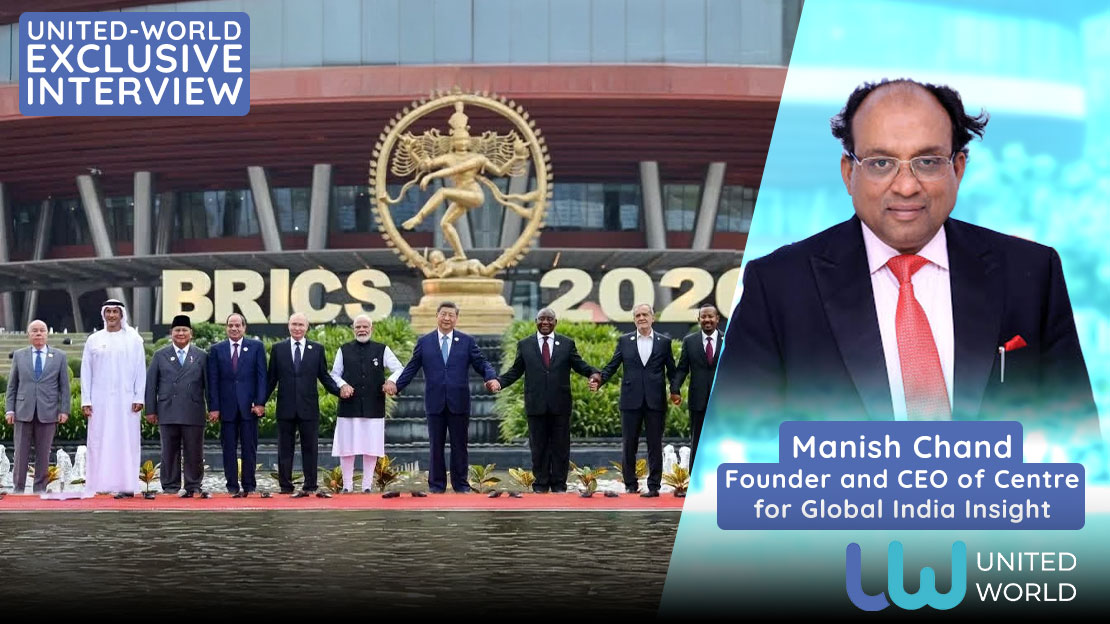
Another BRICS summit has concluded, this time taking place in New Delhi, India. Questions arise regarding the outcomes of the gathering. We asked these to Manish Chand, founder and CEO of the Indian think tank Centre for Global India Insight.
What’s your take on this summit? What was, for your observation, the most important result?
So, you see, the New Delhi summit was highly successful. It was probably the largest gathering of leaders of the Global South. There were 11 members and then 10 partner countries, and all that. I think the New Delhi declaration, that was the culmination of the summit, is a very powerful statement of solidarity of the Global South.
The big takeaway was, I think the Prime Minister Modi emphasized this in his remarks, was reforming. And recasting, reconfiguring the global governance architecture to make it more representative of the voices of the global south in the emerging world.
And he said it very emphatically that the Security Council reforms cannot be stopped any longer. It was a message to the West, you know, that there has been a lot of talk and it’s time to walk the talk. And he also proposed a timeline for reform of the UN Security Council. And global governance institutions, not just UNSC, but also World Bank, IMF, and others. So that was one. Number two was strengthening BRICS as a force of regional peace and stability. And that came out very clearly that India used very deft diplomacy to bridge divides between Iran and UAE on one hand, and they managed to get a joint declaration, and, you know, they. Managed to get both the rival parties to agree to a formulation which talks about exercising maximum restraint, avoiding actions that aggravate insecurity in the world. So, I think this was also a statement of peace and that what role BRICS can play in a world riven by conflicts and crisis. So, that was another thing. And the third takeaway was if you look at the outcomes here, this was the most people centric BRICS summit in some ways. You have something like 50 pragmatic outcomes concrete, tangible outcomes that will decisively transform the lives of people living in over 3 billion people living in BRICS countries if they’re implemented.
What kind of practical applications do you expect following the summit?
So, you have initiatives like BRICS Startup Innovation Network, BRICS Agriculture Network, Smart Electricity, Smart Grid, and a whole lot of other things, you know, Logistics Supply Chain Network. So, by and large, this was a very successful summit. It puts people at the heart of the BRICS agenda. So, it moves away from geopolitical conflicts to shape a people centric approach towards BRICS. And the fourth point also was that to strengthen BRICS as a fulcrum of global growth. You know, in this regard, the BRICS country decided to enhance intra BRICS trade and investment, economic integration.
Today, you know, the world is undergoing a major crisis. There’s a churning in the world order, and most of the countries are under pressure from unilateral tariffs imposed by the United States. Trade protectionism is on the rise, and all that. So, against that backdrop, these emerging economies, which account for now over 40 of global GDP, can play a stabilizing role, can be a beacon of growth, so to speak.
Thank you very much.