

By Adem Kılıç, Political Scientist
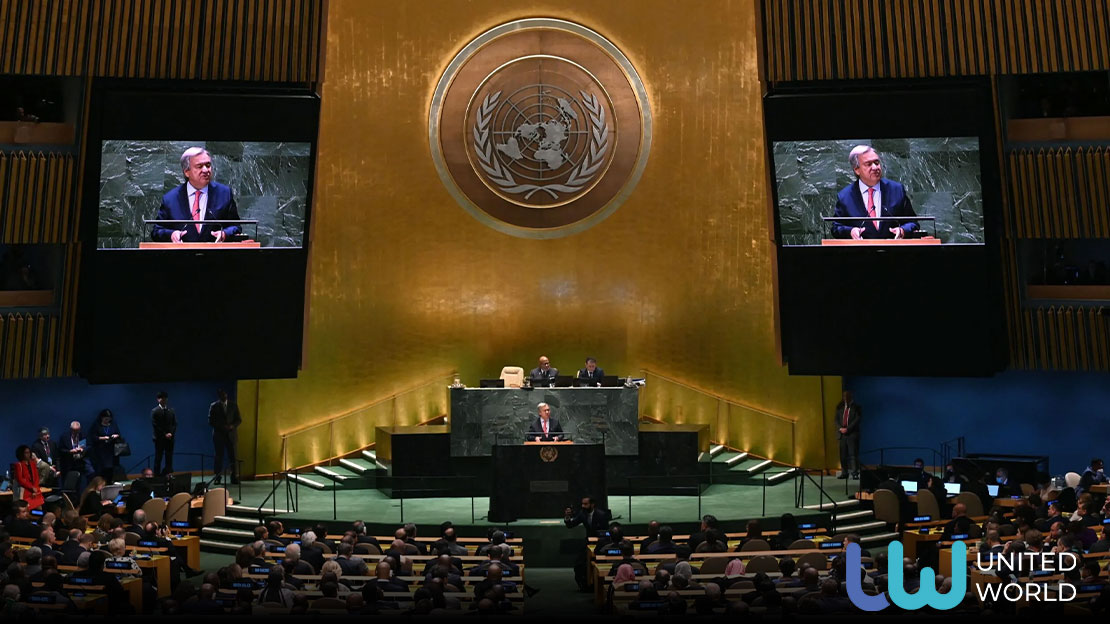
The United States will not only host the new session of the United Nations General Assembly this week.
In my view, the main issue will be reopening the debate over how functional the international system established after World War II is today.
Because as many leaders, led by President Erdoğan, arrive in New York for the 81st General Assembly of the UN, they are raising the same question more loudly regarding global crises ranging from Ukraine to Gaza, from the Iran war to Sudan.
“Can the United Nations really ensure international peace and security anymore in a world where the great powers cannot agree?”
It is precisely for this reason that President Recep Tayyip Erdoğan’s approach of “A more just world is possible,” which he expressed at the 60th UN General Assembly in 2005, when he attended it for the first time during his tenure as prime minister, is becoming the center of a debate that may find greater resonance in this year’s General Assembly atmosphere.
Because in 2005, President Erdoğan, while still prime minister, stated from that podium at the 60th UN General Assembly that a fair international order was necessary, that global inequalities needed to be reduced, that representation needed to be ensured, and that the UN should act in accordance with the ideals upon which it was founded.
In the following years, this approach became concrete with the slogan “The world is bigger than five,” and it became clearly evident that the existing structure, based on the veto power of the five permanent members of the UN Security Council, could not solve the world’s problems and even caused harm.
At the point reached today, this debate is no longer merely a reform proposal put forward by Türkiye.
Gaza and Ukraine have revealed the limits of the system
The most striking feature of today’s international environment can be summarized as a debate not so much over the existence of the UN, but over the extent to which it is able to exercise the powers it possesses.
Since it began earlier, let me state this first. The war in Ukraine has emerged as one of the clearest examples of this.
In Africa, Sudan, Iraq, Afghanistan, or more broadly in the non-Western geography, no problem
Because Russia and China are permanent members of the UN Security Council, the council was unable to produce a binding decision that could end the conflict in an environment where one of the parties to the war possessed veto power.
Because the United States is a permanent member of the UN Security Council, the council was unable to stop what is described as the largest genocide in modern history in Gaza.
Moreover, UN Secretary-General Antonio Guterres also clearly emphasized that violations of the UN Charter and international humanitarian law in crises such as Gaza, as well as the war in Ukraine, directly affect the credibility of the organization.
In fact, Gaza made this problem even more visible. On the one hand, UN bodies produced decisions and calls concerning a ceasefire, humanitarian aid, and the protection of civilians, while on the other hand, developments on the ground revealed that these mechanisms no longer had the capacity to achieve results.
A similar picture emerged with regard to the International Criminal Court.
The ICC issued arrest warrants for Israeli Prime Minister Netanyahu and Gallant, who was Israel’s Defense Minister at the time, on November 21, 2024.
The court announced that it had concluded that there were “reasonable grounds” concerning war crimes and crimes against humanity in relation to certain acts in Gaza. However, these decisions could not be implemented either.
Moreover, the fact that Netanyahu is set to take the podium at the UN General Assembly this week despite the ICC arrest warrant clearly demonstrates how international law is disregarded by this world order.
Furthermore, the fact that the United States did not grant a visa to Palestinian President Mahmoud Abbas, whose country is under occupation and genocide, and prevented him from attending the summit, also clearly demonstrated the extent of the hypocrisy of this Western-centered system.
Therefore, at this UN Summit, the fundamental question that President Erdoğan has been raising for years has now become the main agenda item for all world leaders.
The world is bigger than five!
However, President Erdoğan’s thesis should not be interpreted merely as “opposing five countries.”
At the center of the issue is the structure of the UN Security Council, which carries the distribution of power from the post-World War II era into today’s world.
Because the United States, Russia, China, the United Kingdom, and France, as the five permanent members with veto power, occupy a different position from the other 188 members in the system’s decision-making mechanism.
But we see that the world of 2026 is now very different from the world of 1945.
Different in terms of balances, different in terms of power multipliers, different in terms of population, and different in terms of influence.
Asia’s economic and political weight has grown. Africa’s population and geopolitical importance have increased. Numerous actors, particularly Türkiye, Pakistan, India, Brazil, Japan, and African countries, are questioning the representational capacity of the existing system.
Therefore, the issue of Security Council reform is no longer merely an issue raised by Türkiye.
In fact, the UN itself states that intergovernmental negotiations on Security Council reform are continuing. However, these negotiations have not been concluded for years.
Which issues will come to the fore in New York this year?
The 81st General Assembly is beginning, and the UN’s official theme this year is summarized as “Rebuilding trust and reigniting global ambition.”
The slogan of the summit has also been determined as “A United Nations delivering results for all.”
These themes actually tell us something; even at first glance, this theme shows that the trust crisis currently facing the organization has moved to the center of the international system.
But in my view, the center of gravity of the diplomatic agenda will be much more intense.
The genocide in Gaza, the Iran war, the Russia-Ukraine issue, and regional security debates will be among the hottest topics of the UN Summit.
In fact, in my view, the fact that Iranian President Pezeshkian and Israeli Prime Minister Netanyahu will address the General Assembly on dates very close to each other will also bring the diplomatic dimension of the crisis on the US-Israel-Iran axis to the center of the summit.
Ukraine will be another major issue. The fact that Zelenskyy and Russian Foreign Minister Lavrov will speak at the General Assembly shows that the war will continue to confront each other on the diplomatic front as well.
Moreover, Zelenskyy announced in a statement that they had agreed to meet with Trump in New York.
This meeting shows that the UN General Assembly could become not only a platform where speeches on Ukraine are delivered, but also a diplomatic center where contacts concerning the future of the war take place.
In addition, Sudan, climate change, rising sea levels, development, artificial intelligence, nuclear weapons, and the UN’s financial crisis will also be on the agenda.
Why is Türkiye playing a critical role?
Türkiye’s weight at this year’s General Assembly emerges as a fundamental element in all of the issues I have outlined.
Because Türkiye now stands out not merely as a country positioned between the West and the East, but as almost the only country capable of establishing diplomatic contact among actors that have difficulty speaking to one another.
Türkiye’s simultaneous activity on the NATO, Europe, Black Sea, Middle East, Caucasus, Balkans, Africa, and Asia files demonstrates that Türkiye is a center for resolving many crises.
In the Ukraine war, Türkiye’s position in the Black Sea, its ability to maintain relations with both Russia and Ukraine simultaneously, its experience with the grain corridor, and the diplomatic contacts that emerged after the war made Türkiye’s mediation capacity visible.
The Gaza issue has made Türkiye one of the actors capable of maintaining simultaneous contact with both the West and Russia, Western countries, and the Islamic world.
President Erdoğan’s UN program this year will also center on Gaza and all these issues.
Therefore, President Erdoğan’s speech at the UN General Assembly will not be merely a speech followed by Türkiye.
More broadly, it will mean once again presenting Türkiye’s alternative approach to the current crisis of the international system.
Conclusion
All these developments show that the world has entered a period in which more crises are occurring, while the mechanisms established to resolve these crises are no longer functioning.
For this reason, the UN reform approach and the “The world is bigger than five” position that President Erdoğan has defended for years have today become a broader international reality.
At this summit, the main issue will now be to question much more openly how compatible the power architecture established in 1945 is with the political, economic, and demographic realities of 2026.
Because the fundamental question facing the world is no longer simply, “Does the UN exist?”
The real question now is whether the UN will choose suicide by insisting on being governed according to the power balances of 1945 that have been left behind, or whether it will try to survive through the realities of 2026.