


UWI author and political scientist Dr. Onur Sinan Güzaltan was a live guest on Türkiye’s Ulusal Kanal.
Güzaltan answered questions on the UN General Assembly and President Erdoğan’s article on the issue, the Mecca Alliance and the latest developments in the region, as well as the near-term outlook for the situation in Ukraine.
We share the interview with our readers.
—————————
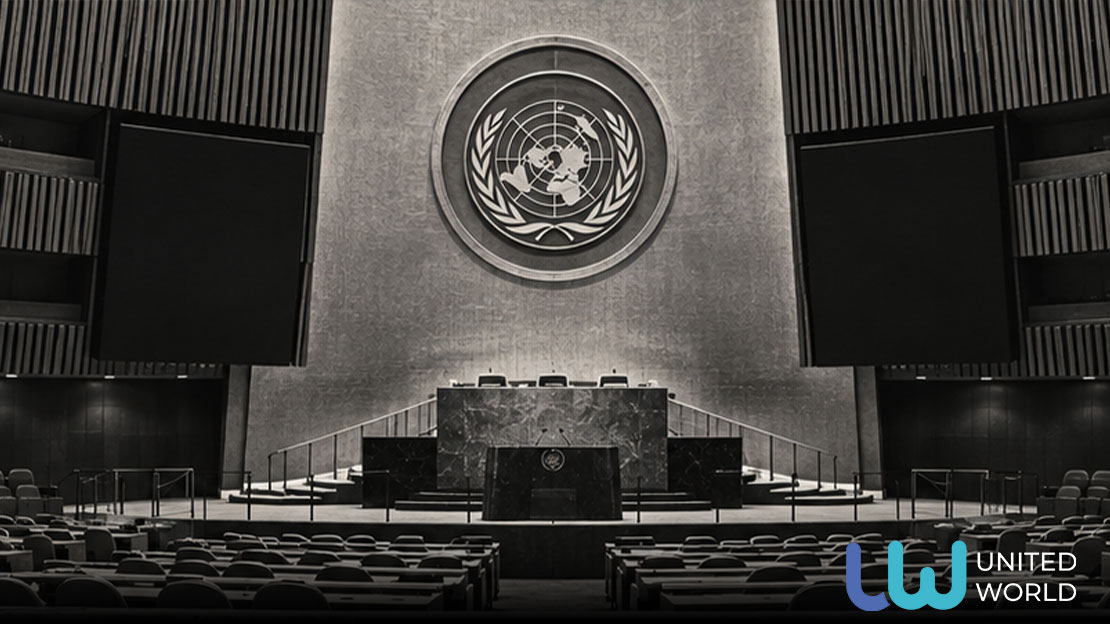
Heading up to the UN General Assembly President Erdoğan wrote an article where he advocates the abolition of the veto privilege in the UN. He also calls for reform of it. Do you think these are possible?
This is not a call coming from President Erdoğan alone; It is a demand shared more broadly across the Global South. Similar calls and similar language can also be found in the declarations of the Shanghai Cooperation Organization.
There are many assessments and arguments that the current structure of the UN Security Council, established after the Second World War, no longer responds to the needs of today’s multipolar world. And there are growing demands for change. Africa, Latin America, Asia and West Asia are not properly represented in the UN Security Council as it currently stands. The point President Erdoğan raised in the article you mentioned ahead of his UN visit should also be read in this context.
The UN, particularly after the 1990s, the collapse of the Soviet Union, became an institution that can hardly be described as genuinely effective. We have seen this in many cases, from the Yugoslav civil war to the intervention in Libya, the invasion of Iraq and the developments in Syria, and most recently the attack on Iran and the abduction of Venezuelan President Maduro by the US. In all these cases, the UN, with its existing structure, was unable to produce a tangible solution.
What we have today is a structure inherited from WW2 and the Cold War, one that has lost much of its functionality, is dominated by the US and is incapable of meeting the needs of a multipolar world. At the composition of the Security Council, Western states carry disproportionate weight. And this is not limited to the UN. The latest BRICS declaration made the same point: All these institutions, the UN, the World Trade Organization, the World Bank, the World Health Organization, that were shaped by the Western-centered world order are now losing their functionality. I wouldn’t call the thing to do a “revision”, “reshaping” or “restructuring”. The existing global international structure as a whole needs to be dismantled and rebuilt according to the realities and requirements of the present day. For that reason, when I look at current issues, the war in Ukraine, in Iran, Yemen and so on, I don’t expect the UN to produce a concrete solution for these.
Let’s look at Türkiye. How do you assess the developments in Yemen, the rising tensions and their wider impact, particularly within the framework of the Mecca Alliance? And where does Türkiye stand in all this?
The US and its regional outpost Israel have failed to subdue Iran. They have tried in different ways. They tried to change the government and political leadership in Iran. That failed. They resorted to military intervention and economic sanctions and most recently, they threatened countries doing business with Iranian airlines. But failed again and again: The US is no longer the sole hegemonic power in West Asia and can no longer simply impose its will. And Israel is weakening demographically and is facing economic, political and cultural crises. The Yemen issue has to be assessed against this broader reality.
Saudi Arabia has long been one of the key pillars of the petrodollar system, the system that, in global terms, helps sustain the American empire. Iran and Yemen have dealt a major blow to this petrodollar system by closing both the Strait of Hormuz and the Bab el-Mandeb Strait. This is really what lies behind the anxiety in Washington and Tel Aviv. They are trying to find a way out. Their own power is insufficient, so they are seeking to use regional states against Iran, Yemen and the Houthis while avoiding the need to expend too much of their own resources. After all, US military power is no longer what it once was.
In these circumstances, Türkiye and the counties in the region need to be extremely careful. They should also stay away from sectarian conflicts and from an approach based solely on regional rivalry.
In Yemen, Türkiye’s role should go beyond simply aligning itself with Riyadh. It should keep channels of dialogue open with Iran and work with another major regional power, Egypt. Perhaps an Ankara-Tehran-Cairo-centered framework could develop policies aimed at producing a regional solution to the Yemen issue and to the tensions between Yemen and Saudi Arabia. Unfortunately, however, we are hearing scenarios under the Mecca Agreement in which Türkiye could become involved in the conflict on Saudi Arabia’s side. That would be an extremely dangerous direction for Türkiye and the region.
Where should we place Türkiye-Egypt relations at this point?
If we look specifically at Türkiye-Egypt relations, ties between the two countries became strained and were effectively severed after the Arab Spring. But in recent years, the two sides have moved toward normalization through various channels. The Eastern Mediterranean, however, remains a structural issue between the two countries. Ankara and Cairo need to take concrete steps on the Eastern Mediterranean, particularly regarding maritime zones, the energy resources beneath the sea and how those resources are to be shared. Relations between Türkiye and Egypt can only become truly structural and durable if the Eastern Mediterranean issue is resolved. If that issue remains unresolved, and relations are built solely around trade or a few relatively small investments, then the relationship will remain tactical and short-term. The key to a structural solution lies in the Eastern Mediterranean. If Türkiye and Egypt handle the issue openly and sincerely, neither the Greek Cypriot Administration of Southern Cyprus, nor Greece, nor Israel can build a hegemony in the Eastern Mediterranean.
Let’s turn to the Russia-Ukraine conflict lastly. What do you expect in the period ahead?
To answer that, we first need to look at what is happening within Europe itself.
The centrist governments, the established political order are currently collapsing. The AfD is rising, the governing party, Merz’s party, is suffering a major decline. There are also remarkable gains by parties on the left. If you look at the polls published in France concerning the 2026 elections, there are surveys suggesting that the second round could be contested by figures outside the political center: Mélenchon, the leader of the left-wing movement, and Marine Le Pen, the leader of the National Front. The entire political center represented by Macron is fading away.
A new period is beginning in Europe. But the centrist establishment and the major economic capital circles behind it are now taking steps that could provoke an even larger war, a possibly directly confrontative, without proxy forces standing between the two sides, with Russia in order to preserve their power.
If these “centerists” lose power, this would not simply be another election result. We would be talking about the collapse of the system that has been established in Europe since the Second World War. That would be an enormous historical moment.
The world has therefore entered an extremely dangerous period. The danger of a world war is increasing by the day, both along the Europe-Russia fault line and along the US-Israel-Iran fault line.
We are living right in the middle of this process. Humanity may not yet fully comprehend the period it is living through, but when the history books describe these years in the future, people will probably read about what is happening today with astonishment.
Türkiye therefore needs to be extremely careful amid this growing fire. It must stay away from the projects drawn up by the US and instead move toward deeper cooperation with the countries of the region.