


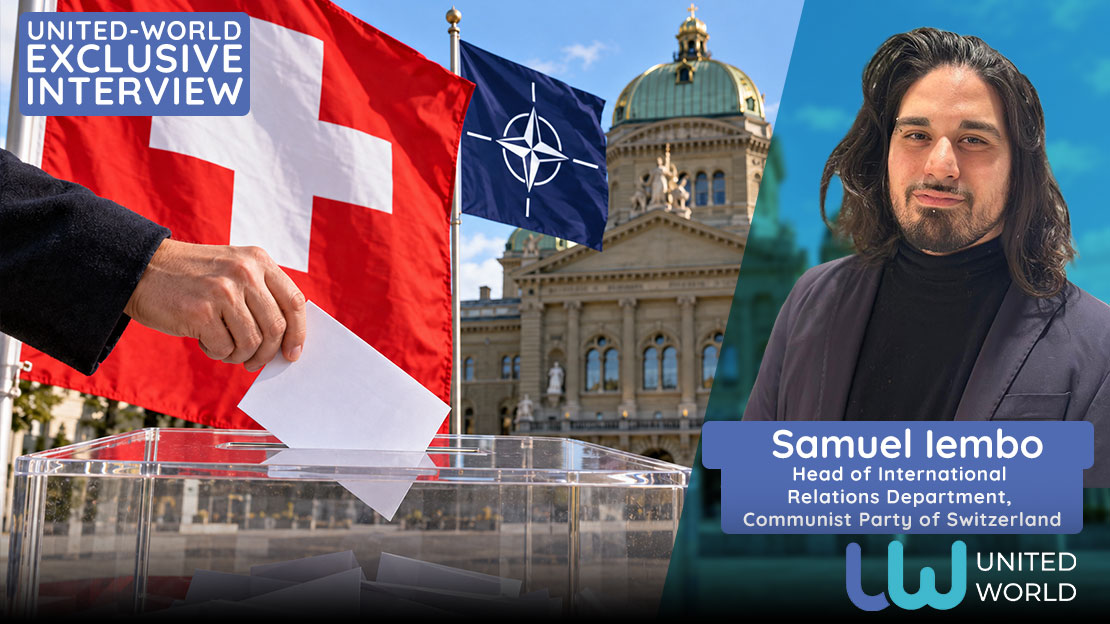
Protests against militarization and NATO policies are widening in the entire European continent. In some countries, they take also an institutional path of rejection. One of these was Switzerland, where the population was called to vote in a referendum on a proposal that strengthens the country’s neutrality and rejects sanctions’ policies, measures that often accompany militarization of foreign policy by civil means.
The proposal was by majority rejected. Still, it has gained ground in the country’s rejection of militarization, says in interview with UWI Samuel Iembo, member of the Central Committee and the head of the International Department of the Communist Party of Switzerland, one of the political forces that campaigned for the proposal. In the Swiss canton of Ticino, the party’s stronghold, was where the proposal got the biggest support. Here’s how Iembo describes the campaign and the path ahead.
You had recently an interesting referendum in Switzerland. What was it about?
Yeah, the referendum that we had was launched in 2022 after Switzerland introduced sanctions against Russia. The major right-wing party, the conservative party in Switzerland, launched this referendum to inscribe in the constitution of Switzerland a definition of neutrality. Because right now, neutrality is only mentioned in the Swiss constitution, and this would have inscribed that the neutrality of Switzerland would have been armed and would have been defined by not taking part in any military alliances and not taking sanction against belligerent countries. That for us would have been progressive initiative, and so we supported it fully.
And how did the campaign go? How were the debates about it?
Well, we constructed a campaign from a left point of view, so we focused on the fact that we would not have to join NATO, and that we could go on with historic diplomatic position of Switzerland. We saw that in the Russian-Ukrainian conflict, Switzerland was taken out of place. Peace conferences were not held in Switzerland, not the relevant one, at least.
So we did a campaign with other left movements from progressive and peace points of view to show that, if we do accept this initiative, we will have Switzerland not just outside of the risk of war, but we will be a table of discussion for all of the conflicts that are coming by in Europe and around the world.
Has it become a major topic in the public opinion, media, news?
Well, it depends on the moment, but actually, it has been talked about a lot because a lot of people, because a lot of people care about neutrality in Switzerland. People of Switzerland really care about the history of Switzerland being neutral. Then, debate was about what neutrality means. A lot of center-right and center-left parties were saying, ‘we will still be neutral, but neutrality has to be active in some ways. So we have to take positions.’
This was their main point. They were saying that we wouldn’t have been able to take sanction against some countries like Israel if we do accept this initiative.
Their counterpart was composed by left movement like us and the conservative right we which were in favor of this topic. So there was a long, a long discussion about it during not just during the referendum. And before the referendum, but in the last three years about this topic, which was developing around this kind of issues.
As a result, for now, your proposal has been rejected. What’s going to happen now? How do you interpret the numbers? Why was it rejected?
It was rejected by far in most of Switzerland, except the Italian Canton in which we are the strongest, and was there it was rejected by just two percent of the votes. But in the rest of the country, was seventy percent. So it was a strong majority that rejected the initiative. That was also because the propaganda was so strong, and they defined this initiative to be the Putin initiative, pro-Putin initiative. That Putin would have voted yes. How we would be become really close to Russia with this initiative was, of course, a lie. And also about the sanction towards Israel, that would have been also a lie because it’s impossible that Switzerland would take sanction against Israel in this moment, as it’s really close to the European Union, and a sanction towards Israel would never come by the European Union or the Euro-Atlantic system. So that was idealistic from those movements that said that we could not sanction Israel.
But as this kind of propaganda really works for the people because of the fear, then it was fully rejected because of this kind of fear that they installed in the in the population. You could see that because two years before the vote, there was a strong majority, at least it was debatable that it could have won.
But months before the vote, as the propaganda strengthened it, the survey became more clear that it was going to lose. So, we took the stance that this was still an opportunity to get this issue on the agenda of the public opinion. And now, we will continue to have public events and demonstrations about the issue of neutrality, because we think it’s still crucial, and it will become more crucial even in the in the next year.
The right-wing conservative movements will probably drop it, because it was just a stance to say that they care about neutrality. But they’re opportunists, and so they will leave it because it will not bring votes for them in some ways.
But we will continue to do that, and we will link it to be against joining and getting close to the European Union. We will have a referendum on discussion and agreements towards the European Union next year in 2027, and we will have to link neutrality of Switzerland and being outside the European Union, always from a left point of view, saying that we are for diplomacy and peace and not going inside this Euro-Atlantic system that will leave us out of peace. That system will get us into war at some day, and also takes labor rights and civil rights from us, because the European Union takes out labor right from its members. So, we don’t want to join and want to be closer to this kind of structure.